
A Manuscript by Tanizaki, Showing the Evolution of His Writing Style
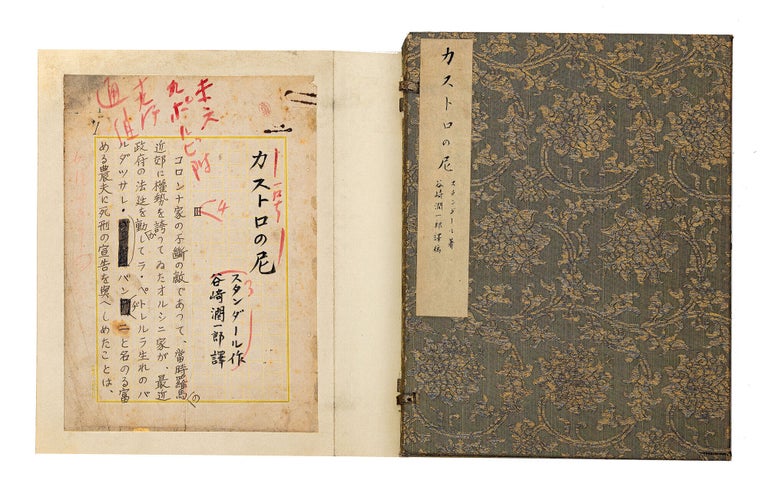
Autograph working manuscript on paper of the third installment of Tanizaki’s translation into Japanese of Stendhal’s L’Abbesse de Castro.
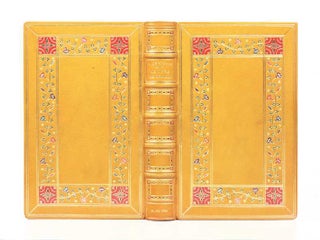
50 leaves (260 x 185 mm.) on Tanizaki’s pre-printed paper, 10 columns per page, each leaf carefully mounted on board & bound in orihon (accordion) format. 8vo (296 x 217 mm.), watered silk over boards. [Kyoto: 1928].
Tanizaki (1886-1965), one of the towering figures of 20th-century Japanese literature, began his literary career in 1909. His early works were written in a straightforward novelistic style, but this began to change in the 1920s, in large part due to his frequent translations of stories and novellas by Western authors including Wilde and Baudelaire (1919), Tagore (1924), and above all, Hardy and Stendhal (in 1928). Tanizaki had long admired Stendhal’s 1839 novella L’Abbesse de Castro, which he read in C.K. Scott Moncrieff’s English translation. Influenced by Hardy’s and Stendhal’s narrative techniques, plot lines, and devices, Tanizaki began to experiment while incorporating a renewed interest in Japanese history and aesthetics. This new “essay-fiction” resulted in a series of masterworks including Arrowroot (1931), Ashikari (1932), and A Portrait of Shunkin (1933), all of which employed structures from Western works, especially those of Hardy and Stendhal. He summarized his theories on the beauty of the mechanics of the Japanese language in his important 1934 essay Bunshō tokuhon (Style Manual), where he acknowledged the importance of the translation process of Western texts in shaping his own style of writing.
The first three parts of Tanizaki’s translation of L’Abbesse de Castro (from Scott Moncrieff’s English translation) appeared in the literary magazine Josei, under the title Kasutoro no Ama カストロの尼, in January, February, and April 1928. Tanizaki was obliged to abandon the project because the magazine ceased publication; no further parts appeared.
Tanizaki dictated the first version of his translation to an assistant, then rewrote and reworked it, until it completely became his own style. Our manuscript is a working version with every page containing revisions, additions, and numerous deletions. It was clearly the draft sent to the printer (there are instructions by the printer regarding font size, pronunciation marks, etc., throughout, written in red).
Early Tanizaki literary manuscripts are rare on the market.
PROVENANCE: Preserved in a silk-brocade covered chitsu, with the characteristic handwriting of Mr. Mori, the chief bibliographer of the great dealer Sorimachi Shigeo 反町茂雄 (the “H.P. Kraus of Japan”) on the label of the upper cover of the box. With the seal (getsumeisō 月明荘) reserved for Sorimachi’s finest items on the final leaf of the manuscript and the inside of the chitsu. The label on the upper cover of the manuscript, again in Mori’s hand, states (in rough trans.): “Tanizaki’s own handwriting, translated draft.”
In fine condition.
Price: $12,500.00
Item ID: 11523