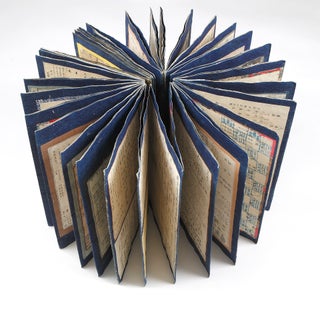
![Item ID: 11579 Manuscript on paper, entitled on upper wrapper “Gaisen ōsetsu henshi” 外船応接片史 [“A Fragmentary History of Dealing with Foreign Ships”]. Kansai 伊東貫斎 ITŌ.](https://jonathanahill.cdn.bibliopolis.com/pictures/11579.jpg?width=768&height=1000&fit=bounds&auto=webp&v=1791834679)
![Manuscript on paper, entitled on upper wrapper “Gaisen ōsetsu henshi” 外船応接片史 [“A Fragmentary History of Dealing with Foreign Ships”].](https://jonathanahill.cdn.bibliopolis.com/pictures/11579_2.jpg?auto=webp&v=1791834679)
Manuscript on paper, entitled on upper wrapper “Gaisen ōsetsu henshi” 外船応接片史 [“A Fragmentary History of Dealing with Foreign Ships”].
16 leaves, including wrappers. 8vo (250 x 173 mm.), orig. wrappers, stitched. Shimoda: [10 August 1856].
A Japanese official’s intimate record of the first difficult days (21 July-8 August 1856, lunar calendar) following the arrival of Townsend Harris (1804-78) at the port city of Shimoda, where he served as the first American consul general to Japan. Harris’s surprise arrival was unwelcome, and it took a full year before the Shimoda bugyō recognized his diplomatic position. He persisted, and in the following three years, talks between Harris and the shogunate resulted in the Convention of Shimoda in June 1857 and the Treaty of Amity and Commerce, which took effect on 4 July 1859 and essentially opened the Japanese nation to foreign trade.
Our manuscript describes the arrival of the steam frigate San Jacinto at Shimoda, and its narrative continues for over two weeks in a day-by-day diary format. An early entry notes that port officials recorded the names of the chief personages on board: James Armstrong, commander of the American naval forces in Asia, Townsend Harris, and Henry Heusken, the Dutch-speaking interpreter. We learn the details of Harris’s daily conversations and uneasy negotiations with the local bugyō, documents Harris carried for presentation to the shogunate, and everyday life (accommodations, foods, etc.).
On the inside front wrapper is a full-page note, dated September 1856, by Shindō Shūjin 進藤周人 (1803-64), a feudal doctor. He states that his son, Dōissai 道一斎, was a student at the medical school of Itō Genboku 伊東玄朴 (1801-71), the eminent physician of Western medicine. Genboku’s son-in-law Kansai was present in Shimoda and became involved in discussions with the Americans. Kansai compiled a manuscript describing his experiences. Dōissai was shown this document and made this careful copy for his father, who made corrections and annotations in red.
Fine. Accompanied by a modern printed transcription prepared by a member of the Shindō family and privately published (Shimoda: 1969) by Hara Noboru 原昇.
Price: $5,500.00
Item ID: 11579