![Item ID: 11421 Dili zhenji quanshu 地理真機全書 [Compendium on the Profound Principles of Geology]. YUN 黎雲 LI.](https://jonathanahill.cdn.bibliopolis.com/pictures/11421.jpg?width=768&height=1000&fit=bounds&auto=webp&v=1785866123)
Dili zhenji quanshu 地理真機全書 [Compendium on the Profound Principles of Geology].
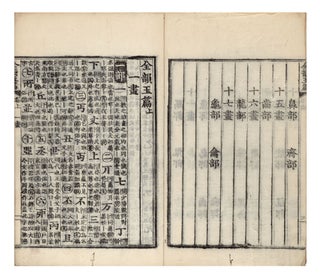
Woodblock-printed. Many woodcut illustrations throughout of geological formations. [3], 4, 3, 62 (f. 47 misbound before f. 46); 61 (f. 32 misbound before f. 31); 58 (ff. 53-54 lacking); 62 (f. 20 duplicated) folding leaves. Four juan in 4 vols. 8vo (218 x 158 mm.), plain paper wrappers (upper wrapper of Vol. I defective), new stitching. [China]: Jusheng tang 聚盛堂, Preface dated 1790.
First edition of Li Yun’s 黎雲 (hao Huafeng shanren 化峯山人) treatise on traditional Chinese geology (dili 地理; kanyu 堪輿; fengshui 風水), with hundreds of woodcut illustrations of land and waterway formations, which sought to demonstrate every common and uncommon geological formation and their variants, is unusual and impressive for the genre. This is very rare book: we find only two other copies, both in China. WorldCat shows only the modern reprint.
The study of geology (Needham uses “geomancy”) in traditional China combined the technical analysis of landscape and waterway formations — described through an eclectic jargon including “dragon veins” (long 龍) and “acupoints” (xue 穴), “eminences” (sha 砂) and “waterways” (shui 水) — with the human concern of constructing appropriate dwellings for the living and the dead. Choosing a site for any architectural construction — from family homes and ancestral graveyards to imperial palaces and mausoleums — required the careful observation of its surroundings, so that the natural and built environments complemented each other harmoniously. By interpreting the anatomy of large-scale mountain ranges (the “dragon veins”) and rivers (the “waterways”), the geologist, much like a physician, skillfully locates the “acupoints” wherein the landscape’s energetic flows concentrate in ways suitable for human dwelling, and refines the position and facing of the architectural construction by further investigating the local terrain (the “eminences”).
“Of all the forms of divination, geomancy was perhaps that which became most deeply rooted in Chinese culture throughout the traditional period. It led to a minute appreciation of the topographical features of any locality, the forms of the hills and the directions and windings of the streams, the presence of woods and flooded rice-fields, the building of pagodas on conspicuous eminences and the contours of city walls. A wealth of technical terms, as yet very imperfectly understood, was applied to the configurations of terrain, connecting together in many varying ways the Yang and the Yin, the dragon and tiger, the earth, planets and stars...Purely superstitious though in many respects they sometimes became, the system of ideas as a whole undoubtedly contributed to the exceptional beauty of positioning of farmhouses, manors, villages and cities throughout the realm of Chinese culture.”-Joseph Needham, Science and Civilization in China, Vol. 4.1, p. 240 (see also Vol. 2, pp. 359-62).
In his Preface, Li Yun writes of the limitation of the earlier, influential geological treatise of Lai Wenjun 赖文俊 (12th cenury), and describes his own apprenticeship under Master Liao 廖公 in Fujian around 1758, with whom he travelled and surveyed many mountains and rivers. Although Master Liao told Li Yun at the time that his was an esoteric knowledge that should be transmitted only with great caution, three decades after his apprenticeship, Li Yun decided to make his master’s teachings public, as he saw the frequent errors committed by geologists of his time. His Preface is dated Qianlong 55 (1790), preceded by the Preface authored by his friend Ding Tong’an 丁烔庵, dated to the same year.
The Compendium on the Profound Principles of Geology eschews the metaphysical calculations based on Yijing hexagrams that dominated major lineages of Chinese geology since the Tang dynasty to focus instead on the analysis of concrete geological formations, which are illustrated throughout the book in hundreds of fascinating diagrams and sketches. The work is divided into four juan, with one juan each devoted to “dragons,” “acupoints,” “eminences,” and “waterways.” In addition to the rich illustrations and discussions of the landscape formations in prose, the Compendium also includes numerous mnemonic verses that summarize the essentials of geology for easy memorization.
The title is not included in the recently published anthology of Chinese traditional divination manuals (Shuzang 術藏, Jiuzhou chubanshe: 2009), whose kanyu category includes over a hundred titles from collections worldwide. We locate only two other copies of the Compendium, held at the National Library of China and the Shanghai Library.
Very good condition. The last leaves of Vol. 4 have light marginal worming, and a few leaves have been repaired. As mentioned above, a few leaves are misbound, and two are lacking in Vol. 3.
❧ Andrew L. March, “An Appreciation of Chinese Geomancy,” Journal of Asian Studies 27, no. 2 (1968): pp. 253-67.
Price: $8,500.00
Item ID: 11421