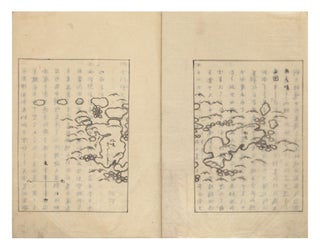
![Item ID: 11484 Carved on both sides & orig. wooden handles, with raised portions of characters & borders on both sides heightened in gold, containing leaves 33-34 of fourth fascicule of Unwajip 雲窩集 [The Collected Writings of Unwa (Cloud Nest)] by Chŏng Hawǒn 鄭夏源. Korean WOODBLOCK.](https://jonathanahill.cdn.bibliopolis.com/pictures/11484.jpg?width=768&height=1000&fit=bounds&auto=webp&v=1785925841)
![Carved on both sides & orig. wooden handles, with raised portions of characters & borders on both sides heightened in gold, containing leaves 33-34 of fourth fascicule of Unwajip 雲窩集 [The Collected Writings of Unwa (Cloud Nest)] by Chŏng Hawǒn 鄭夏源.](https://jonathanahill.cdn.bibliopolis.com/pictures/11484_2.jpg?auto=webp&v=1785925841)
Carved on both sides & orig. wooden handles, with raised portions of characters & borders on both sides heightened in gold, containing leaves 33-34 of fourth fascicule of Unwajip 雲窩集 [The Collected Writings of Unwa (Cloud Nest)] by Chŏng Hawǒn 鄭夏源.
Woodblock (218 x 420 mm.) with handles. [Korea: 1850].
Woodblock prints are invaluable historical artifacts in East Asian history, serving as essential vehicles for the preservation and dissemination of knowledge across centuries. The printing process — whereby ink is brushed onto the carved wooden surface and transferred to paper through sequential impressions — demanded extraordinary skill and meticulous maintenance. Korea’s distinguished woodblock-printing tradition produced remarkable achievements, including the celebrated Tripitaka Koreana (13th century), yet tragically few original blocks survive, having succumbed to wear, warfare, and environmental decay. Extant examples — exceedingly rare outside Korea — provide crucial evidence for understanding early modern printing culture and networks of scholars and ideas.
As mentioned above, the raised portions of the characters and the woodblock’s borders have been carefully heightened with gold pigment. This suggests that the woodblock might have had a decorative purpose following printing. The gold-colored characters remain vivid, creating a visual juxtaposition with the pitch-black surface. Had this block been frequently used as a printing matrix, the raised characters would have been abraded and dulled in color. The preservation of such vibrant coloration may imply the block’s possible commemorative function as a prestige object.
Our woodblock contains leaves 33-34 of the fourth fascicule, which preserve the colophon of Chŏng Ha-wŏn (1762-1833; courtesy name Unwa, or “Cloud Nest”) praising the great 17th-century military official Park In-ro 朴仁老 (1561-1642). It is part of The Collected Writings of Unwa, Chŏng’s six-fascicule-long posthumous literary anthology, compiled and printed by his descendants around 1850.
More than a simple literary work, this colophon reveals how prominent Chŏson families reinforced their social standing through sophisticated acts of cultural validation. In 1831, nearly two centuries after Park In-ro’s death, Chŏng Ha-wŏn edited and published the Nogye Collection, rehabilitating the military official — his fellow Yŏngch’ŏn native — as a scholar-sage. Then, around 1850, nearly two decades after Chŏng’s own death, his descendants memorialized this colophon on the present woodblock. By enshrining their ancestor’s scholarly act in what appears to be a commemorative format, the family likely sought to cement their own prestige as cultural elites rooted in the Yŏngch’ŏn region.
Original Chŏson woodblocks in this fresh condition are extremely rare. Not to be confused with other Unwajip, distinct works of the same title by Hong Jung Sung (1668-1735) and Mok Taerim (1782-1840). Chŏng’s Unwajip has no major holding records, especially outside Korea.
Price: $7,500.00
Item ID: 11484