![Item ID: 11419 Anchun pu 鵪鶉譜 [The Quail Manual]. Shilin 程石鄰 CHENG.](https://jonathanahill.cdn.bibliopolis.com/pictures/11419.jpg?width=768&height=1000&fit=bounds&auto=webp&v=1786128372)
![Anchun pu 鵪鶉譜 [The Quail Manual].](https://jonathanahill.cdn.bibliopolis.com/pictures/11419_2.jpg?auto=webp&v=1786128372)
How to Raise Quails in 17th-Century China
Anchun pu 鵪鶉譜 [The Quail Manual].
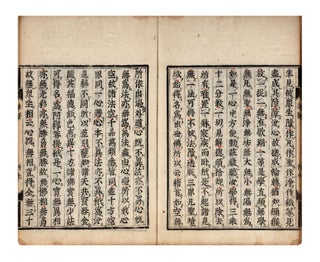
Woodblock-printed. 4, 2, 19; 26 folding leaves. One juan in 2 vols. 32mo (147 x 100 mm.), new wrappers, new stitching. [China]: Preface dated gengyin [1650?].
A fascinating pocket-sized manual for identifying, feeding, and handling quails for fights, which was a popular pastime in premodern China. We find this title only in the Shikaitang 世楷堂 reprints of the Zhaodai congshu 昭代叢書 anthology in WorldCat (accession nos. 1478081079 and 35867803, dated 1849 and 1876 respectively), with copies at Academia Sinica, UChicago, and Harvard.
The once-popular practice of raising quails for spectacular fights, widespread for centuries among Chinese city dwellers, did not leave many written documents behind. The origin of the practice is conventionally traced to the Tang dynasty (618-907 C.E.), and by the Song dynasty (960-1279), literary representations of quail fights were plentiful. But according to the recent study by Leng Yue 冷玥, it was not until the 17th century that works dedicated to the science of quail raising were published in print.
The Quail Manual, authored by Cheng Shilin in 1650 (or 1670, see below), is the earliest extant printed scientific work, covering how to select, feed, train, and care for the birds. According to the Preface, Cheng based The Quail Manual on a palace manuscript already in circulation, correcting errors introduced by its copyists. The book begins with a general essay on quail fighting, followed by 12 entries on identifying strong quails (xiangfa 相法), 44 types of superior quails (shangxiang 上相), 14 types of inferior quails (liexiang 劣相), and three types of unusual quails (zaming 雜名). Our manual offers instructions on how to examine the head, beak, legs, feathers, eyes, and other parts of the bird, and every notable part is given a memorable name such as “Brocaded Tiger,” “Invincible General,” or “Jade Bells.”
The second section of the Manual contains essays on how to prepare captured or purchased quails (yangfa 養法), bath them (xifa 洗法), feed them (sifa 飼法), handle them (bafa 把法), make them fight (doufa 鬪法) and rest (tiaofa 調法), and when to cage them (longfa 籠法). A list of “miscellaneous advices” (zafa 雜法) concluding this section, mostly concerns the quail’s physical health: proper diet, how to deal with diarrhea and parasites, and how to correct its posture.
The final section lists 34 best practices for raising and fighting quails ethically, recommending that one should never kill a losing quail, eat a fat quail, or release any quail unsuitable for fighting, and so on. The reader is also advised against various forms of cheating, such as poisoning and harming the opponent’s quails, as these are inhumane practices (buren 不仁). The section concludes by asking readers to extend their “hearts of benevolence” to their quails (renxin jiwu 仁心及物). This section on sportsmanship advises that one engages in the raising and fighting of quails ethically.
Since quail fighting often involved gambling, it was subject to repeated prohibitions by the Qing government, as a result, despite the game’s persistent popularity, few published titles on quail raising survive. Leng Yue’s study identifies The Quail Manual as the earliest surviving printed book on the subject; based on Cheng’s Preface in a manuscript copy, she dates the work’s first publication to the gengxu year before its inclusion in the Zhaodai congshu (1697-1700) anthology, which would be 1670. However, in our printed copy (publisher’s name absent from title page), Cheng’s Preface is dated to the gengyin year, or 1650. Since the Preface is undated in all other known reprints of the work, it is likely that the 1812 manuscript Leng Yue consults has copied the date erroneously from a now-lost early edition such as ours. Our edition, which is unrecorded elsewhere, generally agrees with the Zhaodai congshu edition (including its 1849 reprint) when it diverges from the 1812 manuscript, but it also contains additional material such as the date of the Preface and the alias of the author (eshiweng 叱石翁), as well as some minor orthographic and organizational differences.
Very good condition, with some marginal chipping, repaired, that only occasionally affects the text. The volumes have been professionally repaired and rebound in the traditional format. A collector’s seal on the first leaf of the table of contents reads 蠹簡齋袁芳榮藏書印.
❧ 冷玥, “明清時期鶉譜流傳情況及所體現的生物學知識,” 古今農業 (2019.2): pp. 67-76; cf. 中國農業古籍目錄 (北京圖書館出版社, 2003), #3444.
Price: $4,950.00
Item ID: 11419