![Item ID: 11185 Ikei kaiwakuron 醫經解惑論 [Elucidation of Questions on the Works of Zhang Zhongjing]. Kitetsu 內藤希哲 NAITŌ.](https://jonathanahill.cdn.bibliopolis.com/pictures/11185.jpg?width=768&height=1000&fit=bounds&auto=webp&v=1776800005)
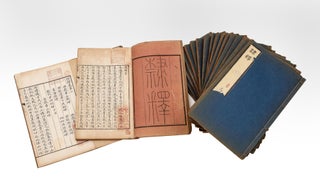
Ikei kaiwakuron 醫經解惑論 [Elucidation of Questions on the Works of Zhang Zhongjing].
47; 35.5; 38; 25.5; 39; 33.5 folding leaves. Three vols. in six. 8vo, orig. semi-stiff wrappers, orig. title-slips, new stitching. Kyoto: Izumoji Bunjirō 出雲寺文次郎 et al.; Edo, 1804.
Second edition (1st ed.: 1776); both editions were posthumously edited and published by Naitō’s son, Eki 繹, and two disciples, Kojima Zui 小島瑞 and Toriumi Kan 鳥海寬, all of whom contributed Prefaces.
Naitō Kitetsu (1701-35), was a highly regarded physician who studied Chinese medicine in Nagano and practiced in Edo. As he left behind only manuscripts, his reputation diminished — in spite of his son’s efforts — until recently, when his writings have attracted much scholarly attention.
Zhang Zhongjing (ca. 150-219 CE) “was a Chinese physician who wrote in the early 3rd century CE Shang han za bing lun [Treatise on Febrile and Other Diseases], which greatly influenced the practice of traditional Chinese medicine. [It]was later edited and divided into two books, Shang han lun [Treatise on Febrile Diseases] and Jin gui yao lue [Jingui Collection of Prescriptions]. Today, Zhang’s work remains highly regarded and important in the practice of Chinese medicine, and he is often referred to as the Chinese Hippocrates…
“Zhang paid close attention to the physical signs, symptoms, kind, and course of a disease, and he carefully recorded the results obtained from any drugs that he prescribed. He forthrightly stood for the dignity and responsibility of the medical profession, and this attitude, coupled with his close powers of observation, make it easy to understand why he has become known by the name of his Greek medical ancestor Hippocrates. In the 16th and 17th centuries there was a strong revival of his teachings and practices” (Britannica, online).
Zhang’s Shanghan zabing lun 傷寒雜病論 [Treatise on Cold Damage and Miscellaneous Disorders] is “the earliest formulary not from archaeological excavations...This formulary brought forth a new system of diagnosis based on the six warps (or stages, liujing 六經) of disease as well as a well-developed taxonomy of diseases. In addition, each of the formulae is given a name, and the dosage and method of preparation of the herbs are specifically described. In fact, this book provides by far the greatest single source of formulae in traditional Chinese medicine. Zhang, who described himself primarily as a collector rather than as a composer of formulae, was the first person we know of to identify the condition of a patient (the diagnosis) with a particular formula used to treat that condition” (Goldschmidt, p. 135).
Zhang’s writings came early to Japan and were widely studied and appreciated until the late 17th century, when certain of his fundamental principles, such as concepts of yin and yang and the channels, came under attack by the Kohōha 古方派 (School of the Old Medical Methods). This marked the beginning of the “Japanization” of Chinese medicine.
In this work, Naitō defends all the principles of Zhang, claiming that Zhang’s Japanese critics had misunderstood his writings. Modern scholarly studies have concentrated on the misunderstandings stated by Naitō.
Both the 1776 and 1804 editions are rare; the first edition is not listed by WorldCat.
Fine and fresh set. Minor and mostly marginal worming.
❧ Asaf Goldschmidt, “Pre-Standardised Pharmacology: Han through Song,” in The Routledge Handbook of Chinese Medicine (2022), pp. 133-45.
Price: $6,500.00
Item ID: 11185