![Item ID: 11205 Ma. Manju isabuha bithe; Ch. Qingwen huishu 清文彙書 [Manchu Collected]. Yanji 李延基 LI.](https://jonathanahill.cdn.bibliopolis.com/pictures/11205.jpg?width=768&height=1000&fit=bounds&auto=webp&v=1770137726)
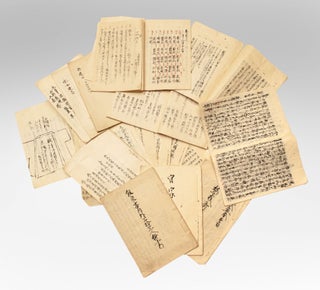
Ma. Manju isabuha bithe; Ch. Qingwen huishu 清文彙書 [Manchu Collected].
[4], 51; 58; 38; 31 (lacking f. 12); 36; 30; 34 (lacking f. 11); 37; 28 (lacking ff. 5 & 7); 30; 35; 30 (lacking f. 25) folding leaves. 12 debtelin in 12 vols. 8vo, old wrappers, old stitching. Beijing: Sanhuai tang (from title-page) & Sihe tang (from Vols. 3 & 10), [Preface dated 1750].
The Manchu Collected by Li Yanji (fl. 1693-1750?) is one of the earliest and most popular Manchu-Chinese dictionaries to be commercially published in Beijing. Li, a Chinese bannerman and “an erstwhile local magistrate in Sichuan and Fujian,” compiled and privately published this dictionary in 12 volumes not long after the appearance of The Imperially Commissioned Mirror of the Manchu Language (Ma. Han-i araha manju gisun-i buleku bithe) in 1708, which marked the beginning of the court’s many efforts to standardize written Manchu in the 18th century. Li rearranged the entries of the thematically organized 1708 Mirror according to the order of the Manchu syllabary (Ma. juwan juwe uju; Ch. shi’er zitou 十二字頭) for easy consultation and substituted the elaborate Manchu-language definitions in the Mirror with succinct explanations in Chinese (Mårten Söderblom Saarela, The Early Modern Travels of Manchu, p. 108).
The union catalogue of Manchu books in Chinese collections compiled by Huang Runhua and Qu Liusheng lists three copies published by Sihe tang 四合堂 during the Kangxi reign (1662-1722) and three copies by an unspecified publisher in 1724, with most extant copies dating to 1751 — a date given on the title pages of copies by three separate publishers (107). Due to its great popularity, from 1750 (date of Preface) onwards Manchu Collected was sometimes printed with woodblocks that had passed (through purchase or loan) from one publisher to another and were partially altered in the process. The title-page on our copy states that it was sold by the Sanhuai tang publishing house near the Longfusi temple in Beijing, but the name of the original publisher is preserved on the first folio of Vols. 3 and 10 as Sihe tang and removed in all other volumes. Furthermore, the year of the Preface, which is usually given as Qianlong 15 (1750), is removed in our copy. Woodblock alterations of this kind are not uncommon for extant copies of this work, and they provide a valuable glimpse into the practices of commercial publishing in 18th-century Beijing. We are aware of at least two copies printed with the same (altered) woodblocks as our copy: University of Chicago M5188/4414B and Inner Mongolian Autonomous Region Library 00480-00491.
In a blogpost on Manchu Collected and its later supplement by Ihing (1747-1809), Annie Zhanling Wang writes that “Manchu dictionaries shed light on how people conceptualized and described women-related practices and ideals in Manchu. Among those, Manchu-Chinese dictionaries — which use Chinese to explain the meaning of Manchu words — show possible gaps between the conceptualization of women-related practices and ideals in Manchu and that in Chinese, since certain Manchu words do not have equivalents in Chinese and have to be explained in full Chinese sentences, while certain Chinese words do not have equivalents in Manchu and require the invention of new Manchu words…[A]s a genre of sources, dictionary can tell us about not only the history of the Manchu language and education, but also women’s history and gender history” (“Qingwen buhui 清文補匯 and the Evolution of Women-Related Manchu Words,” Manchu Studies Group blog, 25 Feb. 2024).
Our copy is in unusually pristine condition, with only occasional light foxing. As mentioned above, five leaves are lacking. A diligent reader has compiled a syllabic index with leaf numbers for each volume, handwritten on the front covers for Vols. 1, 2, 3, 6, and 8 and on a separate, laid-in piece of paper for the other volumes. The “head” for each volume is handwritten on the spine. Another laid-in piece of paper in Vol. 4 contains brief handwritten verses in Manchu and Chinese, signed by Wei Wenfan 魏文藩.
❧ Huang Runhua 黃潤華 & Qu Liusheng 屈六生, Quanguo Manwen tushu ziliao lianhe mulu 全國滿文圖書資料聯合目錄 (Beijing: Shumu wenxian chubanshe, 1991).
Price: $3,500.00
Item ID: 11205