Japanese Spying in Occupied Korea
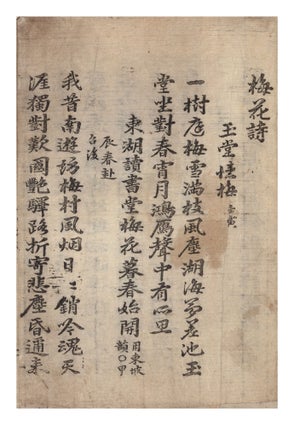
A collection of manuscripts, written on pre-printed paper, in part by Akashi Motojiro 明石元二郎 (1864-1919).
70 folding leaves (all roughly 250 x 170 mm.). Korea: mostly dated between 1910 and 1913.
This fascinating collection comprises a series of handwritten administrative and case notes pertaining to police spying activities, regulations, and security planning in colonial Korea under Japanese rule. The documents were prepared by operatives in the Police Bureau of the Government-General of Chosŏn .
Our documents are diverse in scope, ranging from operational details such as surveillance and sentry procedures at the Amnok River Bridge 鴨緑江橋, the natural border between North Korea and China today (accompanied by a folding colored map of the river), oversight of local shrines and temples, investigations into human trafficking and the abduction of women, and civil police deployment plans covering major port cities.
Certain entries are dated and bear the personal annotations of Akashi Motojiro, who served as Chief of Police in the Government-General of Chosŏn and later became Governor-General of Taiwan. His contributions include a “Proposal to Expand the [Ethnic] Korean Police,” marked “secret” and dated December 1911, as well as memoranda documenting statistics and tallies of Japanese and Korean police officers as of October 1912. Akashi’s involvement underscores the significance of these notes for understanding the structure and priorities of the colonial police.
Japan’s formal annexation of Korea in 1910 inaugurated a colonial regime (1910-45) that employed its police force to maintain public order, suppress dissent, enforce new regulations, and monitor civil society — overseeing everything from resident registration and religious activities to labor and public health. While the “military rule” of the 1910s gave way to a “cultural rule” with some reforms after 1919, police surveillance and public-security operations continued as fundamental mechanisms of control. This collection offers an extremely rare perspective on both the daily operations and the broader institutional planning of Japanese colonial policing.
Fine condition.
Price: $9,500.00
Item ID: 11167