

A Beautifully Drawn “Black Ship” Scroll
Two long & vividly illustrated scrolls providing a Japanese account of the decisive February-April 1854 American expedition, during which the two sides continued to familiarize themselves with each other through gift-giving and entertaining.
11 long & lavishly painted scenes, employing numerous washes of ink in a variety of colors. Two emaki (I: 295 x 6760 mm.; II: 295 x 6800 mm.) with wooden rollers & patterned silk-fabric front endpapers. Japan: [1854-55].
Two brilliantly rendered “Black Ship” scrolls representing Commodore Perry’s return to Japan in early 1854; most of the events depicted in this pair of scrolls are rarely pictured in Japanese materials recounting these consequential months in the history of both countries. The skillful illustrations are uncommonly detailed and more carefully rendered than those found in other scrolls. We also find the present scrolls to be an invaluable counterweight to the official American illustrated account published in the 1856 Narrative of the Expedition of an American Squadron to the China Seas and Japan (among other American books), with its clear advocacy of the United States’ gunboat diplomacy. The scenes within our scrolls show mostly convivial moments as the Americans and Japanese shared their customs, pastimes, crafts, and innovations — sumo wrestling, a telegraph machine, a steam-engine locomotive train, for example. Although the scroll is unsigned, it appears a single artist is responsible for the paintings throughout.
These two scrolls, executed by a talented artist with painstaking attention to detail, are an exceptional visual record of the second Perry expedition of 1854; each of the scenes is a revealing vignette on the evolving relationship between the American interlopers and the Japanese reconciling themselves to the end of their isolationism. Finely illustrated scrolls and books documenting these pivotal moments are especially rare.
Scroll I, Scene I: This scroll begins with American sailors landing their rowboats filled with presents for the Japanese in the days before high-level diplomatic negotiations began. Laden with boxes and barrels, the boats were unloaded on the beach with the assistance of Japanese men, some wearing straw jackets. Members of the American marching band are shown playing their instruments while proceeding from the beach towards the reception hall where discussions are to take place. The Japanese erected a long white sheet barrier to keep the Americans from visiting unauthorized areas adjacent to the beach. A row of American sailors stands in the empty reception hall monitoring the proceedings. Next to the hall is a small Shinto shrine.
Scroll I, Scene II: Americans and Japanese start to interact ashore; for instance, a Japanese guard shows his long spear to a group of Americans, one of whom is holding the spear as well as the guard’s hand-protectors. Further to the left, three American officers appear to be drinking wine while they rest. Another mixed group stands next to a fire, as one of the Americans pours a bucket of water from a well. Next, the two sides stand under a camellia tree; two Americans pull down a branch to collect the flowers. One American officer is examining a flower with an armed Japanese man; another officer shows his patterned blue cape to a Japanese government official. There is also a drummer boy in a bright red uniform. Lastly, two Americans admire a parasol with calligraphy written on it, and a Japanese official describes it to them.
Scroll I, Scene III: The hosts and visitors continue to familiarize themselves with the other’s ways of life. In a martial arts pose, a Japanese man demonstrates sumo wrestling technique, leaving an American sailor crumpled on the ground. We assume this was meant as a friendly demonstration, since two other sailors show little concern. Moving onwards, an American is practicing what looks to be equestrian vaulting in front of a crowd of impressed Japanese warriors.
Scroll I, Scene IV: Three Americans demonstrate their technological prowess with a telegraph machine. This is one of the more detailed depictions of the device we have seen. A wire snakes from the device to a tall pole the Americans have installed. In the foreground, an American sailor playfully throws dirt at one of his hosts.
Scroll I, Scene V: This scroll concludes with a column of American sailors marching, led by four young members of the marching band in red, with a cluster of instrumentalists at the rear. We know that Commodore Perry organized an extravagant and boisterous military parade on the day he first met with Japanese representatives at Kanagawa, in order to impress (or shock?) the Japanese.
Scroll II, Scene I: At the beginning of the second scroll is a panoramic view of the American squadron anchored off Kanagawa, presumably in the days before officials from both sides met at the reception hall to deliberate on ending Japan’s policy of isolationism. The ship on which the scene focuses must be Perry’s flagship, the USS Powhatan, a sidewheel steam frigate. The rest of the American fleet is visible in the background, as are smaller American rowboats and Japanese ships.
Scroll II, Scene II: As a sign of good faith in their negotiations, the shogun supplied the Americans with ca. 200 sacks of rice. Additionally, the Japanese sent 75 large sumo wrestlers to carry the rice to the American camp. The size and strength of the wrestlers astounded the Americans; Perry was even encouraged to playfully punch one in the stomach. The wrestlers are depicted carrying two sacks at a time; one extends his arm fully while lifting the rice.
Scroll II, Scene III: The Japanese entertained the American delegation with sumo wrestling. In this scene, both sides are gathered around a dirt circle, eagerly watching two wrestlers and a referee in the middle of a bout. In several places, Japanese men are explaining the sport to Americans. Behind the wrestling ring, an American officer is poking one of the wrestlers while examining his large body. In the foreground, a Japanese man in a green jacket stands on the tips of his toes to see the bout past the taller Americans and their headwear.
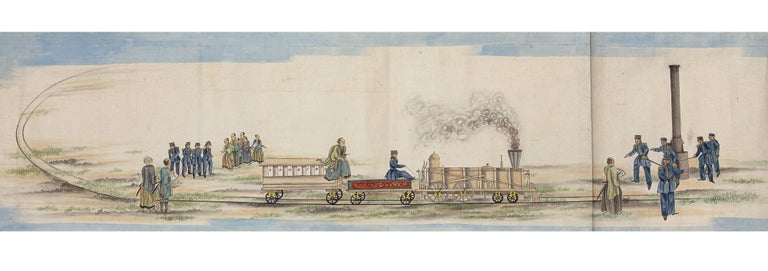
Scroll II, Scene IV: Members of the American delegation demonstrate to the Japanese how they could harness steam to power a small-scale locomotive train. To the right, six sailors stand next to a chimney while a Japanese samurai looks on. The locomotive carries an American engineer, who hand-feeds coal into the furnace, and a Japanese diplomat on top of the passenger car. A group of Americans and Japanese watches, including one Japanese man who is writing or drawing in a book, recording his impressions of this novel technology.
Scroll II, Scene V: On 31 March, the two parties agreed to a final version of a treaty, known as the Treaty of Peace and Amity. This opened Japanese ports to Americans for the first time. To celebrate their agreement, the Japanese hosted an elaborate banquet in the reception hall. The hosts are on the right, and the Americans, including Commodore Perry, sit at a dining table on the left. A column of Japanese men enters from the right carrying dishes to be served to their guests. The table in the middle is replete with a multi-level lacquer box, dishes holding vegetables and condiments, utensils, and a large jug. Confronted with an unfamiliar cuisine, several Americans are pointing at components of the meal, presumably asking their hosts about them.
Scroll II, Scene VI: Deviating from the positive illustrations of the two sides familiarizing themselves each other, this scroll ends with a tense scene in which an American officer in a rowboat has his handgun drawn and pointed at a Japanese man who is leaning forward with his hands raised. We have been unable to ascertain the incident to which this refers. We know about several disagreements and altercations between the two sides stemming from misunderstandings, but these were all de-escalated without a shot fired.
The scrolls are in excellent and fresh condition, housed in a modern wooden box.
❧ Renata V. Shaw, “Japanese Picture Scrolls of the First Americans in Japan,” The Quarterly Journal of the Library of Congress, Vol. 25, No. 2 (April 1968), pp. 134-53.
The Library of Congress’s digital collection “Pacific Encounters in Nineteenth-Century Japan,” provides full high-definition scans of the library’s holdings, and is an invaluable resource for researching this period.
For helpful recapitulations of accounts from the Japanese, Americans, and Russians, we highly recommend William McOmie’s The Opening of Japan, 1853-1855: A Comparative Study of the American, British, Dutch and Russian Naval Expeditions to Compel the Tokugawa Shogunate to Conclude Treaties and Open Ports to Their Ships (2006).
Price: $65,000.00
Item ID: 11481

![Ŏje hunsŏ [or] Oeje hunseo 御製訓書 [Royally. King YŎNGJO 英祖, or YEONGJO.](https://jonathanahill.cdn.bibliopolis.com/pictures/9429.jpg?width=320&height=427&fit=bounds&auto=webp&v=1694208548)