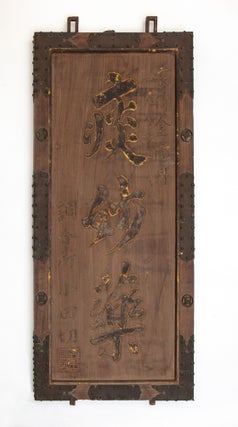
A large wooden announcement board (307 x 963 x 10 mm.), bearing legible calligraphic brushed text & a branded seal, used to announce guidelines regulating a Kyoto art supply merchant guild.
[Kyoto: December 1853].
A most interesting artifact and rare survival, this kōsatsu wooden board presents the latest regulations for a Kyoto guild of art supply merchants, or enoguya kabu 絵具屋株, which primarily dealt in pigments for painting. These Edo-period guilds, kabunakama 株仲間, were granted monopolies by the state to autonomously monitor and administer their trades. In return, the shogunate levied high taxes on the guilds. The Japanese state dissolved most trade guilds in 1842, but this art supply guild seems to have survived these reforms. At the beginning of the Meiji period, all guilds were officially terminated in the interests of modernizing the economy.
Kōsatsu 高札 were wooden public “bulletin boards” displayed prominently to spread important information. This one was presumably hung up in a guild hall where members could review the latest changes to guild rules and government regulations. The regulations for the art supply guild written on this board were first ratified in 1813 and are updated here as of December 1853. They include protectionist measures against Chinese goods. Members were obligated to strictly adhere to these bylaws, which would be self-enforced by the guild. We have roughly translated seven of the rules put forth on our board:
1. We will follow all regulations established by the government.
2. If a guild member deals with any prohibited merchandise, such as paint pigment from China, they will be arrested.
3. Members must remain vigilant about goods of Chinese origin and other banned items. Punishments for handling painting pigments and other merchandise that originate from China are described.
4. The market prices of pigments must be followed, according to guidelines established by the state.
5. Members must regularly report sales to the government. If a member is found to be price-gouging, they will be arrested by the guild.
6. Heirs, employees, and female family members are not allowed to conduct business without a license.
7. If guild members witness immoral practices by other members or other guilds (e.g., pharmacology and Osaka), they must report it.
A compelling object, in fine condition; minor wear to the edges and a couple of holes from the nails used to mount the board.
Price: $5,000.00
Item ID: 10404