![Item ID: 11432 Huangshigong michuan yangzhai biyong 黃石公秘傳陽宅必用 [Essentials for Architecture of the Living, Secretly Transmitted by Master Yellow Stone] [with] Lingqu jiefa dongming zhenyan mishu 靈驅解法洞明真言秘書 [The Secret Book of True Words that Illuminates the Techniques of Exorcising a Haunted House]. Cangru 袁滄孺 YUAN.](https://jonathanahill.cdn.bibliopolis.com/pictures/11432.jpg?width=768&height=1000&fit=bounds&auto=webp&v=1786039164)
![Huangshigong michuan yangzhai biyong 黃石公秘傳陽宅必用 [Essentials for Architecture of the Living, Secretly Transmitted by Master Yellow Stone] [with] Lingqu jiefa dongming zhenyan mishu 靈驅解法洞明真言秘書 [The Secret Book of True Words that Illuminates the Techniques of Exorcising a Haunted House].](https://jonathanahill.cdn.bibliopolis.com/pictures/11432_2.jpg?auto=webp&v=1786039164)
![Huangshigong michuan yangzhai biyong 黃石公秘傳陽宅必用 [Essentials for Architecture of the Living, Secretly Transmitted by Master Yellow Stone] [with] Lingqu jiefa dongming zhenyan mishu 靈驅解法洞明真言秘書 [The Secret Book of True Words that Illuminates the Techniques of Exorcising a Haunted House].](https://jonathanahill.cdn.bibliopolis.com/pictures/11432_3.jpg?auto=webp&v=1786039164)
![Huangshigong michuan yangzhai biyong 黃石公秘傳陽宅必用 [Essentials for Architecture of the Living, Secretly Transmitted by Master Yellow Stone] [with] Lingqu jiefa dongming zhenyan mishu 靈驅解法洞明真言秘書 [The Secret Book of True Words that Illuminates the Techniques of Exorcising a Haunted House].](https://jonathanahill.cdn.bibliopolis.com/pictures/11432_4.jpg?auto=webp&v=1786039164)
![Huangshigong michuan yangzhai biyong 黃石公秘傳陽宅必用 [Essentials for Architecture of the Living, Secretly Transmitted by Master Yellow Stone] [with] Lingqu jiefa dongming zhenyan mishu 靈驅解法洞明真言秘書 [The Secret Book of True Words that Illuminates the Techniques of Exorcising a Haunted House].](https://jonathanahill.cdn.bibliopolis.com/pictures/11432_5.jpg?auto=webp&v=1786039164)
![Huangshigong michuan yangzhai biyong 黃石公秘傳陽宅必用 [Essentials for Architecture of the Living, Secretly Transmitted by Master Yellow Stone] [with] Lingqu jiefa dongming zhenyan mishu 靈驅解法洞明真言秘書 [The Secret Book of True Words that Illuminates the Techniques of Exorcising a Haunted House].](https://jonathanahill.cdn.bibliopolis.com/pictures/11432_6.jpg?auto=webp&v=1786039164)
The “Eight Mansions” Method of Architectural Planning
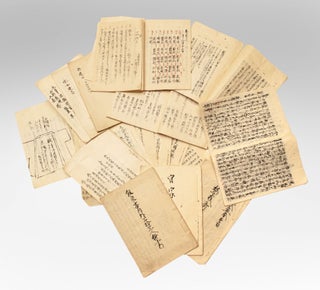
Huangshigong michuan yangzhai biyong 黃石公秘傳陽宅必用 [Essentials for Architecture of the Living, Secretly Transmitted by Master Yellow Stone] [with] Lingqu jiefa dongming zhenyan mishu 靈驅解法洞明真言秘書 [The Secret Book of True Words that Illuminates the Techniques of Exorcising a Haunted House].
Woodblock-printed. Woodcut illustrations, diagrams, & architectural plans in vols. 1-3. [1], 3, 4, 9, 23; 21; 24; 32 folding leaves. Four juan in four vols. 8vo (237 x 150 mm.), new wrappers, new stitching. [China]: Guwu shuye tang 古吳書業堂, title page dated 1821.
An early, comprehensive manual on the “Eight Mansions” (bazhai 八宅) method for determining architectural layouts of human dwellings (yangzhai 陽宅) — a major subdivision of traditional fengshui learning — attributed to Yuan Shizhen 袁世振 (hao Cangru 滄孺, d. 1631), with contributions by Xiong Wenxuan 熊文選 (zi Fengzhou 鳳洲, n.d.) and first published by Zhou Yuwu 周譽吾 (fl. 1620s). This is a very rare work: we locate only another 1821 reprint in WorldCat (accession no. 122838916, held at Columbia), and no institutional holding is identified in China.
When it comes to constructing human residences in traditional China, few considerations are as important as the proper alignment between the greater cosmos, the built environment, and the individual circumstances of human beings that live within it. As Ole Bruun explains, “fengshui is seen to work around homes in various ways. First, the specific natural environment gives shape to flows of qi, for which reason all its features must be identified, including compass directions, topography, symbolic representation of the landscape, flows of water and vegetation. Second, human constructions impinge on each other in such a way that one building may block or pervert the flow of qi to another, making specific evaluations necessary. Third, the possible impact of a range of natural and man-made objects around the home must be evaluated, including trees, rocks, monuments, ponds, dams, pagodas and shrines. Fourth, but of great importance, the astrological data of the household leader must be considered, as well as symbolic interaction between, for instance, his animal sign or birth date and the surroundings. Last of all, in connection with building activity, a number of rituals and local customs must be respected.”-Bruun, An Introduction to Feng Shui (Cambridge: 2008), pp. 60-61.
In his article ”The Origin of Bazhai Feng Shui,” Stephen L. Field observes that although precursors to the “Eight Mansions” method of architectural layout can be traced to the Han dynasty, the method itself is conventionally attributed to the Buddhist monk Yixing 一行 (673-727) and not actually documented and does not appear in print until the Ming and Qing periods. “Eight-house fengshui is thus the culmination of some two thousand years of evolution in the practice of directional site orientation...What began in the Han dynasty as the relatively simple juxtaposition of direction and surname bearing five-phase correlations, eventually developed into a system juxtaposing direction and birth bearing numerological correlations based on the eight trigrams of the Yijing” (p. 186).
According to Essentials for Architecture of the Living, the “Eight Mansions” method of architectural layout examines the combinatorial alignments between the trigrams associated with the orientation of the residence and its various rooms and gates, and the trigrams associated with the fate (that is, time of birth) of its resident. Favorable and unfavorable alignments are signaled by reference to the “Nine Stars,” and more careful examination of the trigrams’ elemental affinities specify the types of misfortunes that might arise in unfavorable alignments: robbery, flood, fire, illnesses of the youth and the elderly, miscarriage, suicide, and so on.
Essentials for Architecture of the Living not only explains the general theoretical frameworks of the “Eight Mansions” method and the details of its numerological calculations, but also provides concrete and hands-on advice on planning multi-building residential complexes, where the size, height, orientation, and function of each building is calibrated to the harmony of the complex as a whole. Vol. 3, contains multiple full-page woodcuts depicting plans of multi-building residences, followed by prescriptions on the placement of paths, mills, stables, wells, kitchens, and water tanks.
Also noteworthy is the short text at the beginning of vol. 1 titled The Secret Book of True Words that Illuminates the Techniques of Exorcising a Haunted House, which contains illustrated descriptions of various talismans that subdue malign spirits (yan 魘) causing illnesses, quarrels, poverty, fires, theft, and such to the household, giving prescriptions of the talismans’ preparation and placement.
The title-page, wrapped in semi-transparent white paper, is dated to Daoguang xinsi (1821) and states the publisher as Guwu shuye tang 古吳書業堂. The Preface, anonymous and undated, attributes the work to Yuan Cangru and Xiong Wenxuan. The beginning of each juan repeats this attribution and further specifies that the edition is published by Zhou Yuwu, a publisher active in the 1620s in Suzhou. As mentioned above, we find only one other copy — also an 1821 reprint, but under a different publisher — in WorldCat, and no institutional holdings in China. The Shuzang 術藏 anthology (2009) uses a Republican-era lithographic reprint of this work.
Very good condition, with light staining and marginal worming, as well as occasional handwritten annotations in black ink. Professionally repaired and rebound in the traditional format. Preserved in a hantao.
❧ Stephen L. Field, “The Origin of Bazhai Feng Shui,” in Feng Shui (Kan Yu) and Architecture International Conference in Berlin (Harrassowitz: 2011), pp. 185-200.
Price: $5,500.00
Item ID: 11432