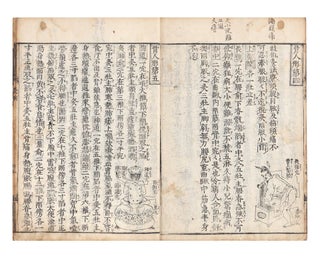
![Item ID: 9446 Shi jia zhai yang xin lu 十駕齋養新錄 [Records for Nurturing New Virtues & Bringing Up New Knowledge from the Studio of “Riding for Ten Days”]. Daxin 錢大昕 QIAN.](https://jonathanahill.cdn.bibliopolis.com/pictures/9446.jpg?width=768&height=1000&fit=bounds&auto=webp&v=1694206846)
An Edifice of Learning Built Piece by Piece
Shi jia zhai yang xin lu 十駕齋養新錄 [Records for Nurturing New Virtues & Bringing Up New Knowledge from the Studio of “Riding for Ten Days”]
with yu lu 餘錄 [further records] in the supplement. 20 & 3 juan in six vols. 8vo, orig. wrappers (lower wrapper of final vol. torn), new stitching. [China]: 1806.
First edition of this collection of scholarly notes or “jottings” (biji 筆記) by one of the leading Chinese intellectuals of the 18th century, Qian Daxin (1728-1804).
“The gentleman says: Learning must never stop.” Thus reads the first sentence in the ancient philosophical work Xunzi. Further on, the philosopher expounds on what great things can be achieved by going about them little by little: “Let the horse Qi Ji [famous for its reach] take a single leap; / It still would go no farther than ten strides; | Yet old nags ridden ten days [shi jia 十駕] equal him; / Not giving up is where success resides.” The title of Qian’s book is a reference to these lines. The occupant of the “Studio of ‘Riding for Ten Days’” assembles his evidence slowly, piecing together a solid edifice of learning. This meticulous assemblage served to “nurture new virtue [yang xin de 養新德] and bring up new knowledge [qi xin zhi 起新知].” This second reference, ultimately from the writings of a Song-dynasty philosopher, Qian had borrowed from the studio name of one of his ancestors.
Together, the two allusions in the title of Qian’s book illustrate the ethos of “evidential learning,” a trend in Chinese scholarship of which Qian — academy director and tutor to one of the imperial princes — has always been considered one of the most prominent representatives. In his Records and its supplement, Qian included studies of Chinese philology, phonology, history, historical geography, mathematics, education, and their various subgenres.
Shi jia zhai yang xin lu carries two Prefaces: one by the author dated 1799 and one by Ruan Yuan 阮元 (1764-1849) dated late in 1804. Some sources give 1804 as the first date of printing. However, our copy also has a colophon by Qian Dongshu 錢東塾 (n.d.), Daxin’s second son, dated late in 1806. The book was reprinted several times, and our copy does not carry an imprint of any of these later editions.
Our copy has a seal with the imprint hongxue ling guan 紅雪詅館, from an unknown previous owner.
Fine set, preserved in a hantao. Minor worming.
References
Gu Jichen 顾吉辰. “Jiading Qianshi Qianyan Tang quanshu (Guangxu chongkan ben) shishou zhushu kao” 《嘉定钱氏潜研堂全书》(光绪重刊本)失收著述考. In Qian Daxin yanjiu 钱大昕研究, edited by Gu Jichen. Shanghai: Huadong ligong daxue chubanshe, 1997.
Sela, Ori. China’s Philological Turn: Scholars, Textualism, and the Dao in the Eighteenth Century. New York: Columbia University Press, 2018.
Xunzi: The Complete Text. Translated and edited by Eric L. Hutton. Princeton: Princeton University Press, 2014.
Yao Jirong 姚继荣. Qingdai lishi biji luncong 清代历史笔记论丛. Beijing: Minzu chubanshe, 2014.
Price: $3,950.00
Item ID: 9446