![Item ID: 9434 Fang guang bo re bo luo mi jing 放光般若波羅蜜經 [S.: Pañcaviṃśati-sāhasrikā-prajñāpāramitā-sūtra; Perfection of Wisdom in 25,000 Lines]. MOKṢALA 無叉羅, trans ZHU-SHU-LAN 竺叔蘭.](https://jonathanahill.cdn.bibliopolis.com/pictures/9434.jpg?width=768&height=1000&fit=bounds&auto=webp&v=1694206184)
![Fang guang bo re bo luo mi jing 放光般若波羅蜜經 [S.: Pañcaviṃśati-sāhasrikā-prajñāpāramitā-sūtra; Perfection of Wisdom in 25,000 Lines]](https://jonathanahill.cdn.bibliopolis.com/pictures/9434_2.jpg?auto=webp&v=1694206184)
![Fang guang bo re bo luo mi jing 放光般若波羅蜜經 [S.: Pañcaviṃśati-sāhasrikā-prajñāpāramitā-sūtra; Perfection of Wisdom in 25,000 Lines]](https://jonathanahill.cdn.bibliopolis.com/pictures/9434_3.jpg?auto=webp&v=1694206184)
A Sutra from Late Imperial Central China
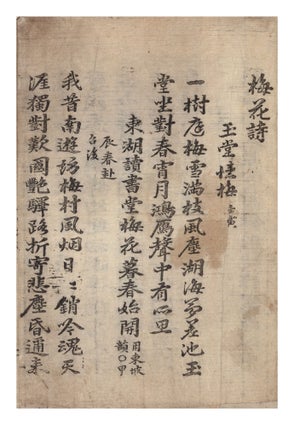
<i>Fang guang bo re bo luo mi jing</i> 放光般若波羅蜜經 [S.: <i>Pañcaviṃśati-sāhasrikā-prajñāpāramitā-sūtra</i>; <i>Perfection of Wisdom in 25,000 Lines</i>]
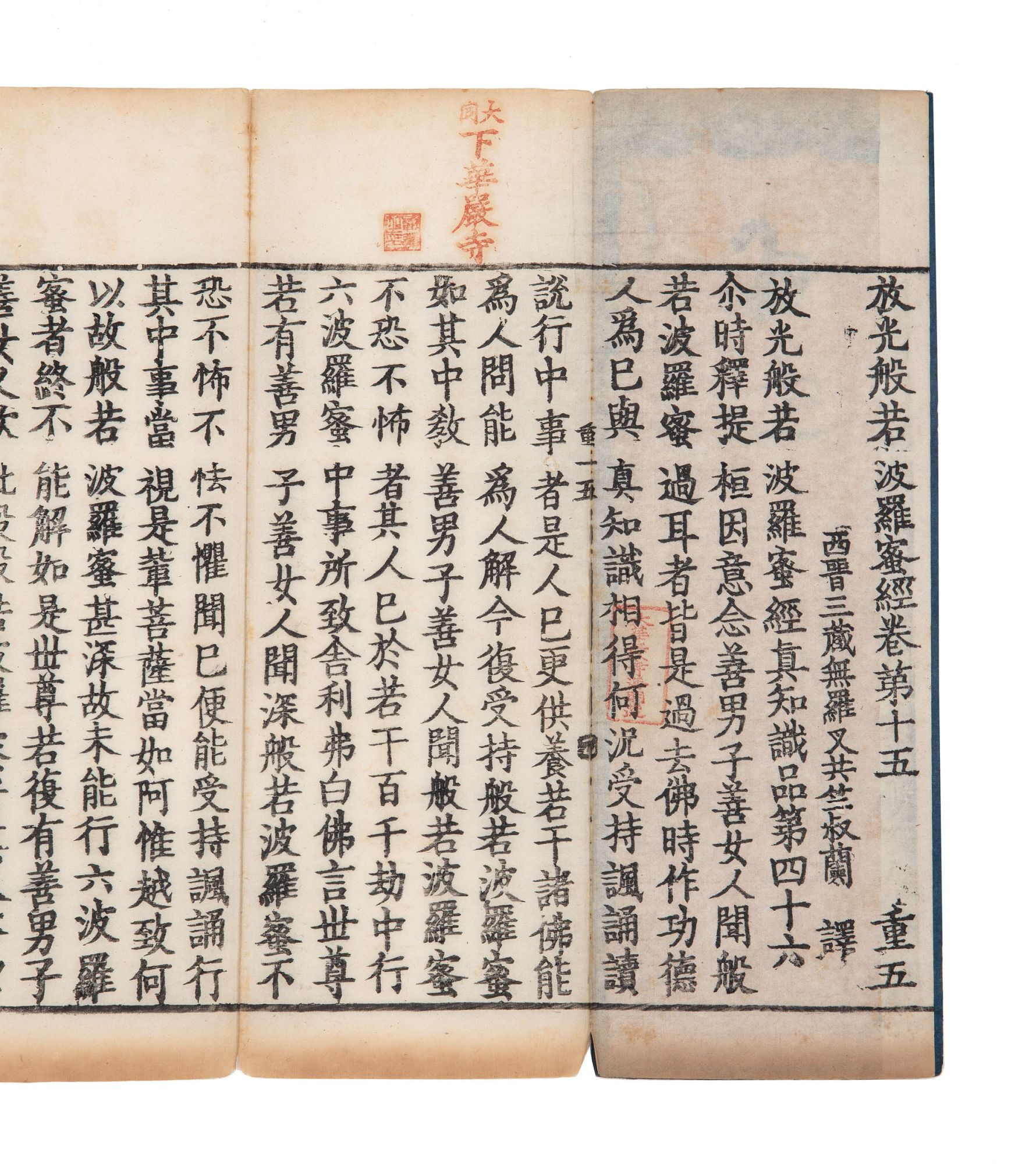
One juan (juan 15). Six columns per page, 17 characters per column. 75 pages. Height of printed text including woodcut borders: 244 mm.; total length: 8475 mm. Tall narrow 8vo (327 x 113 mm.) in accordion format, orig. sutra binding of silk-covered boards (upper cover with blue silk, lower with orange silk), wood-block printed title label on upper cover. [China]: Ming or Qing dynasty.
A fine and rare copy of a Ming or Qing period printing of this sutra. This work, Fang guang bo re bo luo mi jing, “is not a direct translation from the original Sanskrit text, but an abridged translation” (Digital Dictionary of Buddhism), by the Khotanese monk Mokṣala 無叉羅 and the Indian monk Zhu-shu-lan 竺叔蘭, carried out in 291 CE under the Western Jin 晉 dynasty. The Sanskrit original of the sutra had been acquired by the Chinese monk Zhu Shixing 朱士行, who travelled to Kustana (Khotan) on a pilgrimage in 260 CE. In 282 CE, he sent the sutra to China with his disciples. The translation was carried out at Shuinan Si 水南寺 temple in the vicinity of Kaifeng in today’s Henan province. It was the first major prajñā, “wisdom” sutra, translated in the Western Jin, introducing concepts such as the emptiness of nature in all things (xingkong 性空), and the “two truths” (er di 二諦) of ultimate and conventional truth, among others. It is “one of the three most important of the ‘large’ Prajñāpāramita sutras.”–Buswell & Lopez, The Princeton Dictionary of Buddhism, p. 618.
Our copy of juan 15 of the sutra carries the seals of the lower (xia 下) complex of Huayan Si 華嚴寺 temple in Datong in present-day Shanxi province of China. This temple was founded in the 11th century, but Buddhist temples had existed on the site even earlier. The separation of an “upper” and “lower” temple happened sometime between the late 15th and the late 16th century.
One of the sutra’s seals reads, “created by Haiming of the Great Huayan Temple” 大華嚴寺海明造. We find conflicting information regarding Haiming. A cursory mention in the secondary literature suggests that he lived in the late Jin-early Yuan period, corresponding to the late 12th to early 14th century. Yet another piece of scholarship cites a note accompanying a partial set of a Tripitaka made at Bao’en Si 報恩寺 temple in the lower Yangzi and currently held at Huayan Si temple. The note says that the Tripitaka was brought back to Huayan Si temple by one Haiming 海明 in 1672 (Kangxi 11). The exact date of printing remains unknown.
The sutra carries the ordinal characters zhong wu 重五, meaning the fifth of the juan labelled with the character zhong from the Thousand Character Essay (Qianzi wen 千字文), which was used to order the contents in the Chinese Tripitaka. This sutra is thus marked in several editions of the Tripitaka printed in late imperial China.
References
Digital Dictionary of Buddhism. http://www.buddhism-dict.net/ddb/
He Mei 何梅. Lidai Hanwen Dazangjing mulu xinkao 歷代漢文大藏經目錄新考. Beijing: Shehui kexue wenxian chubanshe, 2006.
Shanxi lishi wenhua mingcheng jianzhu yaolan 山西历史文化名城建筑要览. Datong: Shanxi jingji chubanshe, 2017.
Wang Yingtian 王银田 and Cao Yanling 曹彦玲. “Datong Huayan Si yanjiu” 大同华严寺研究. https://www.163.com/dy/article/GT1A8TLP0552DWVT.html Retrieved August 8, 2023.
Price: $7,500.00
Item ID: 9434