
With Much Printing in Hangul
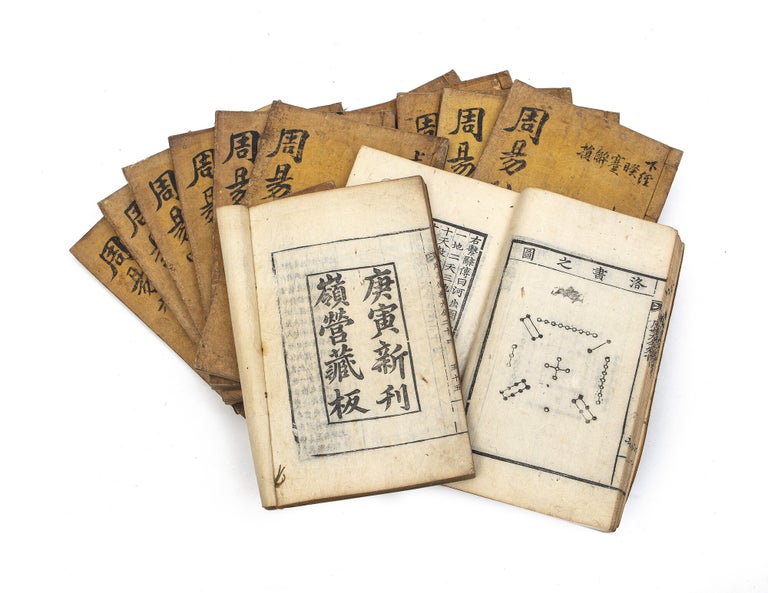
Chuyŏk chŏnŭi taejŏn pyŏng ŏnhae 周易傳義大全幷諺解 [The Zhou Changes: The Complete Commentary with Vernacular Explanations].
Woodblock-printed. 1, 24, 9 kwŏn in 19 vols. Small folio (345 x 224 mm.), orig. semi-stiff wrappers with handwritten titles on upper covers, old stitching. Korea: Yŏngyŏng, Kyŏngin, [1830].
A handsome set of two Korean editions of the Classic of Changes (Ch. Yijing 易經 or Zhouyi 周易), published together in Yŏngyŏng 嶺營 (today’s Daegu city). The first work, the Complete Commentary, synthesizes the two major Changes commentaries by the Neo-Confucian philosophers Cheng Yi 程頤 (1033-1107) and Zhu Xi 朱熹 (1130-1200). The second, the Vernacular Explanations, is the official rendering of Changes into vernacular Korean pronunciation, written in a mix of hanja and hangul scripts. Published by the court and reprinted throughout the kingdom, these editions reflected the official interpretations of the Confucian classic and therefore constituted the most important part of a scholar’s education in Chosŏn Korea (1392-1897).
Although both are authoritative editions of the Changes, the Complete Commentary and the Vernacular Explanations were composed in drastically different circumstances for different audiences. The Complete Commentary, in 25 kwŏn, belonged to a set of official commentaries on the Confucian Classics compiled by the Ming court, under the direction of Hu Guang 胡廣 (1370-1418), which aimed to establish as state orthodoxy the great Neo-Confucian writings of the Song period. Almost immediately after its completion in 1412, the Complete Commentary was adopted by the Korean court as the standard edition of the Classics. It was re-published in several printings during the following centuries.
The Vernacular Explanations of the Classics, in nine kwŏn, compiled by the Korean court nearly two centuries later, in 1590, follows a very different format from a traditional commentary. Instead of exegetical notes on individual words and phrases, Vernacular Explanations adds to the original Chinese texts word-by-word phonetic glosses written in the Korean hangul alphabet, grammatical glosses (K. t’o 吐) that rearrange Chinese words in accordance with Korean syntax, and Korean paraphrases written mostly in hangul.
In her detailed study of the Vernacular Explanations and their precedents in Korea, Prof. Si Nae Park emphasizes that this edition should not be understood as a “translation” of the Classics into vernacular Korean as it was spoken at the time, but rather an official codification of the voice of a tutor that guides the student through the pronunciation of individual graphs, the interpretation of the glosses, and the resulting Koreanized reading of the original texts. “The Chosŏn state created the Vernacularized Classics as books that inscribe the voice of an imaginary tutor’s vocalization of the Confucian Classics in the vernacular language for Chosŏn readers to imitate...the efforts in constructing the Vernacularized Classics were fundamentally about how best to fine-tune the tutor’s voice as a standardized reading sound for the Classics and...in so doing, the Vernacular Classics introduced a new and privileged vernacular linguistic register.”–Park, “The Sound of Learning,” p. 32. That an edition of the Classics was devoted entirely to standardizing the Korean pronunciation likely owed to the emphasis placed on oral recitation and memorization in Zhu Xi’s pedagogical philosophy.
Our copy was printed in Yŏngyŏng using woodblocks carved from the chŏngyuja 丁酉字 movable-type edition published during the Chŏngjo reign (1776-1800). Printing with woodblocks carved from a royal typographic edition was a common practice in early modern Korea, and the resulting copies are frequently miscatalogued as typographic themselves. As extant Yŏngyŏng woodblocks typically date between 1822 and 1832, the woodblocks for our copy, dated to the kyŏngin 庚寅 year in the colophon, were likely carved 1830.
In fine and fresh condition. The fifth volume of the first series has some small staining.
❧ 崔完植, “朝鮮時代刊行中國思想關係書概況,” 人文論叢 24 . 김남기, “규장각 소장 嶺營藏板의 현황과 성격,” 영남학 61 (2017), pp. 7-33. Si Nae Park, “The Sound of Learning the Confucian Classics in Chosŏn Korea,” HJAS 79, Nos. 1 & 2 (2019), pp. 31-87.
Price: $25,000.00
Item ID: 11597