![Item ID: 11526 Jippunimon shiyō shō 十不二門指要鈔 [Essentials of the “Ten Gates of Nonduality”]. SIMING ZHILI 四明知禮.](https://jonathanahill.cdn.bibliopolis.com/pictures/11526.jpg?width=768&height=1000&fit=bounds&auto=webp&v=1787950377)
![Jippunimon shiyō shō 十不二門指要鈔 [Essentials of the “Ten Gates of Nonduality”].](https://jonathanahill.cdn.bibliopolis.com/pictures/11526_2.jpg?auto=webp&v=1787950377)
![Jippunimon shiyō shō 十不二門指要鈔 [Essentials of the “Ten Gates of Nonduality”].](https://jonathanahill.cdn.bibliopolis.com/pictures/11526_3.jpg?auto=webp&v=1787950377)
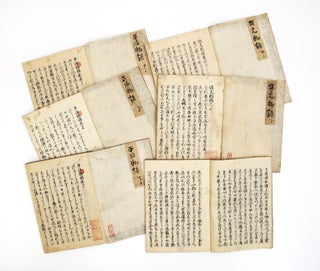
Jippunimon shiyō shō 十不二門指要鈔 [Essentials of the “Ten Gates of Nonduality”].
Double line borders on three sides, ten columns per page, 20 characters per column. 35 folding leaves. Two kan in one vol. 8vo (270 x 180 mm.), orig. wrappers stained dark brown with fermented persimmon juice to prevent worming (nevertheless, wrappers a little wormed), new stitching. [Japan]: [ca. 1615-44].
One of two known copies of a rare movable type or kokatsujiban edition, not in Kawase, Sorimachi, NIJL, or WorldCat. Our copy is the same edition as that in the Daitōkyū kinen bunko 大東急記念文庫 of the Gotoh Museum.
The Shi bu’ermen zhiyaochao 十不二門指要鈔 (Preface dated 1004, T. 1928) is an explanation of the meditation on the “ten gates of nonduality,” authored by Siming Zhili 四明知禮 (960-1028), 17th patriarch of the Tiantai (J. Tendai) School of Buddhism and a key figure in its revitalization and factional debates in the Song period. Meditation on the “ten gates of nonduality” by examining the ordinary mind, including the nonduality of forms/mind, inner/outer, culture/nature, cause/effect, and so on, was first prescribed in the eponymous text (T. 1927) by the ninth patriarch Jingxi Zhanran 荆溪湛然 (ca. 711-82) as an entryway into the quintessential Tiantai view known as “three thousand worlds in a single thought” (Ch. Yinian sanqian 一念三千).
As the Tiantai philosophical system — one of the oldest in East Asian Buddhism — became challenged by the emergent Pure Land (Ch. Jingtu; J. Jōdō 淨土) and Chan (J. Zen 禪) schools in the Song period, much of their doctrinal differences were debated through competing commentaries on the “ten gates of nonduality.” Zhili’s Shi bu’ermen zhiyaochao, written during what is known as the Shanjia-Shanwai schism, maintain the Tiantai interpretation of the meditation against two earlier commentaries on the same text by Shanwai (lit. “Off-Mountain”) thinkers, who were more sympathetic to Chan and Huayuan teachings on the nature of mind and reality. Rather than accepting that in meditation one is contemplating the perfectly enlightened mind from which all phenomena arise, “Zhili insisted that the unenlightened ordinary mind was the proper object of meditative practice...[and] held that each and every element of reality whether it be material or mental contained in its nature the totality of everything else.”–Daniel Aaron Getz, “Siming Zhili and Tiantai Pure Land in the Song Dynasty,” Ph.D. diss. (Yale: 1994), pp. 90-91.
Our book opens with the Preface of the renowned Tiantai monk Zunshi 遵式 (964-1032), who was Zhili’s close associate. The main text, rather unusually, prints Zhanran’s original text alongside Zhili’s line-by-line commentary; the original is printed flush against the top frame, and the commentary is indented by one space. The undated colophon in our copy clarifies that this layout follows that of an earlier Chinese edition.
The only copy of this work recorded in Kawase’s well-known study of kokatsujiban is in the Takagi Collection of the National Diet Library, which is of a different edition (no rules around text and without Zhanran’s original text). We locate only one other copy of our edition, in the Daitōkyū kinen bunko of the Gotoh Museum (shelf no. 362), which belonged to the famous 19th-century book collector Inada Fukudō 稲田福堂. Kawase, who compiled Vol. 2 of the rare book catalogue of the Daitōkyū kinen bunko, suggested the edition could be an Eizan ban 叡山版, published at the Enryakuji monastery complex on Mount Hiei outside of Kyoto, sometime during the Genna or Kan’ei periods (1615-44). The red rectangular seal in our copy is difficult to read, but the last of its three characters is probably 山.
A very good and crisp copy, preserved in a most attractive chitsu. With some worming, mostly confined to the gutter or lower margins, occasionally touching a few characters. A few of the final leaves have some worming.
❧ 大東急記念文庫書目 (1955), p. 498. 大東急記念文庫貴重書解題 (1956), Vol. 2, p. 183. Cf. 川瀬一馬, 増補古活字版之研究 (ABAJ: 1967), p. 348 (National Diet Library copy).
Price: $9,500.00
Item ID: 11526