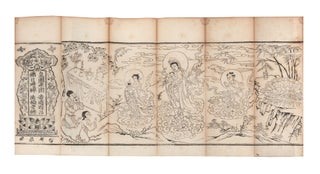
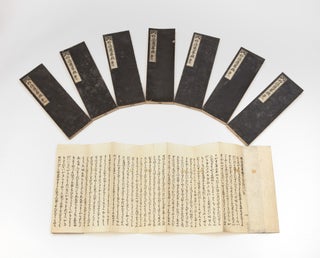
![Item ID: 11525 [Jippunimon] kongenshō [十不二門] 根源抄 [Commentary to the Essentials of the “Ten Gates of Nonduality”]. SIMING ZHILI 四明知禮.](https://jonathanahill.cdn.bibliopolis.com/pictures/11525.jpg?width=768&height=1000&fit=bounds&auto=webp&v=1787949526)
Unknown to Kawase, NIJL, & WorldCat
[Jippunimon] kongenshō [十不二門] 根源抄 [Commentary to the Essentials of the “Ten Gates of Nonduality”].
Printed with wooden movable type. Single line border around text, 13 columns per page, 18 characters per column. 43; 49; 55 folding leaves. Three kan in three vols. 8vo (283 x 198 mm.), orig. persimmon-stained semi-stiff wrappers, new stitching. Japan: [ca. 1624-45].
One of two known editions printed with movable type; our edition is not in Kawase, NIJL, or WorldCat. This copy appeared as item 419 in Sorimachi Shigeo’s famous 40th-anniversary Cat. 42 (1972), devoted to kokatsujiban. Sorimachi suggests that our edition is possibly an Eizan ban 叡山版, published at the Enryakuji monastery complex on Mount Hiei outside of Kyoto.
The Commentary to the Essentials of the “Ten Gates of Nonduality” is an anonymous, undated, and noncanonical commentary to the Shi bu’ermen zhiyaochao 十不二門指要鈔 (Preface dated 1004, T. 1928), an explanation of the meditation on the “ten gates of nonduality” authored by Siming Zhili (960-1028), 17th patriarch of the Tiantai (J. Tendai) School of Buddhism and a key figure in its revitalization and fractional debates in the Song period.
Meditation on the “ten gates of nonduality,” by examining the ordinary mind, including the nonduality of forms/mind, inner/outer, culture/nature, cause/effect, and so on, was first prescribed in the eponymous text (T. 1927) by the ninth patriarch Jingxi Zhanran 荆溪湛然 (ca. 711-82) as an entryway into the quintessential Tiantai view known as “three thousand worlds in a single thought” (Ch. Yinian sanqian 一念三千). As the Tiantai philosophical system — one of the oldest in East Asian Buddhism — became challenged by the emergent Pure Land (Ch. Jingtu; J. Jōdō 淨土) and Chan (J. Zen 禪) schools in the Song period, much of their doctrinal differences were debated through competing commentaries on the “ten gates of nonduality.” Zhili’s Shi bu’ermen zhiyaochao, written during what is known as the Shanjia-Shanwai schism, maintains the Tiantai interpretation of the meditation against two earlier commentaries on the same text by Shanwai (lit. “Off-Mountain”) thinkers, who were more sympathetic to Chan and Huayuan teachings on the nature of mind and reality. Rather than accepting that in meditation one is contemplating the perfectly enlightened mind from which all phenomena arise, “Zhili insisted that the unenlightened ordinary mind was the proper object of meditative practice...[and] held that each and every element of reality whether it be material or mental contained in its nature the totality of everything else.”–Daniel Aaron Getz, “Siming Zhili and Tiantai Pure Land in the Song Dynasty,” Ph.D. diss. (Yale: 1994), pp. 90-91.
Caught in the middle of heated and consequential doctrinal debates, the meditation on the “ten gates of nonduality” generated a large body of commentarial literature over time, much of which does not survive. This anonymous Commentary to Zhili’s text only survives — to the best of our knowledge — in a few copies printed in 17th-century Japan. The NIJL, following Kokusho sōmokuroku, attributes the title to the Nichiren monk Nisshō 日昭 (ca. 1221-1323), but neither Sorimachi nor Kawase follows this attribution, and Nisshō’s name does not appear anywhere within the Commentary. The text itself is a very close, phrase-by-phrase explanation of Zhili’s work and is probably meant to be read alongside it. It backs up Zhili’s highly polemical prose with many supporting scriptural quotations and sometimes illustrates doctrinal terminology with simple diagrams, using type of varying sizes (a rare typographic feature at the time). The opening pages explain two motivations for composing a commentary on the “ten gates of nonduality”: to provide an easy entrance into the complex Tiantai meditation system outlined in the Mohe zhiguan 摩訶止觀 (T. 1911), and to make a clear and accessible explanation of the “ten gates” available to new generations of practitioners.
This Commentary is not included in any of the major Buddhist canons and survives only in four 17th-century Japanese editions: two woodblock editions dated Kyō’an 1 (1648) and Kanbun 9 (1670), respectively, and two movable type or kokatsujiban editions without dated colophons. Each of the two movable type editions has one known copy. Our edition has a single line around the text, and the first title line is indented by five spaces, whereas the other movable type edition, exemplified by the copy in the Iwazaki Collection of the Tōyō bunko, has double-line borders around the text, and the first line is indented by only one space. The two editions are otherwise similar, with the same numbers of columns, characters per column, and leaves. The type for our copy is considerably less worn, resulting in a cleaner impression. Visual collation of the four editions shows that the two woodblock editions follow the Tōyō bunko edition in indentation and allography.
PROVENANCE: From the library of Frank Hawley, whose 寶玲文庫 seal is at the beginning of the text. Hawley was one of the most discerning of all collectors of Japanese books and manuscripts; he never bought a boring book. See R.H. van Gulik’s “In Memoriam. Frank Hawley (1906-1961)” in Monumenta Nipponica, Vol. 16, No. 3/4 (Oct. 1960-Jan. 1961), pp. 434-47. It passed from Hawley to the collector and bibliographer Nakajima Ninosuke (1894-1969), whose seal reads 春翠文庫.
Very good copy. Minor worming, some traditionally repaired. In a new chitsu.
❧ 反町茂雄, 弘文莊古活字版目錄: 創業四十周年記念 (弘文莊: 1972), #419 (this copy, p. 430 with illus. on p. 423). For the Tōyō bunko copy see 岩崎文庫和漢書目錄 (Tōyō bunko: 1934), p. 39. 国書総目録 (岩波書店, 1989-91), p. 141 (cf. p. 599). 岩崎文庫貴重書書誌解題 II (Tōyō bunko, 1998), pp. 8-9. 川瀬一馬, 増補古活字版之研究 (ABAJ, 1967), p. 348 (erroneously described as two kan).
Price: $9,500.00
Item ID: 11525