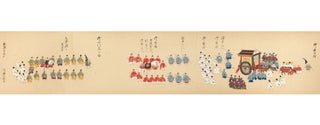
![Item ID: 11486 [In Japanese, first line]: Issai nyorai shin himitsu zenshin shari hokyoin darani 一切如来心秘密全身舎利宝篋印陀羅尼 [S: Sarvatathāgatatattvasamgraha; C: Yi qie ru lai xin mi mi quan shen she li bao qie yin tuo luo ni jing; Sutra of the Whole-Body Relic Treasure Chest Seal Dharani]. SUTRA KŌFUKUJI 興福寺 PRINTING.](https://jonathanahill.cdn.bibliopolis.com/pictures/11486.jpg?width=768&height=1000&fit=bounds&auto=webp&v=1786387827)
![[In Japanese, first line]: Issai nyorai shin himitsu zenshin shari hokyoin darani 一切如来心秘密全身舎利宝篋印陀羅尼 [S: Sarvatathāgatatattvasamgraha; C: Yi qie ru lai xin mi mi quan shen she li bao qie yin tuo luo ni jing; Sutra of the Whole-Body Relic Treasure Chest Seal Dharani].](https://jonathanahill.cdn.bibliopolis.com/pictures/11486_2.jpg?auto=webp&v=1786387827)
Printed in the Late 11th or Early 12th Century
[In Japanese, first line]: Issai nyorai shin himitsu zenshin shari hokyoin darani 一切如来心秘密全身舎利宝篋印陀羅尼 [S: Sarvatathāgatatattvasamgraha; C: Yi qie ru lai xin mi mi quan shen she li bao qie yin tuo luo ni jing; Sutra of the Whole-Body Relic Treasure Chest Seal Dharani].
Scroll on paper, 24 lines per dharani, 17 characters per line, body of the woodblock text: 240 x 494 mm., consisting of two joined sheets (r: 553 mm., l: 585 mm. in length), sutra text printed twice. Scroll (290 x 1138 mm.), with later endpaper (68 mm.) at beginning (total length: 1206 mm.), on a wooden roller (some worming to text, faint staining at foot). [Most certainly Kofukuji Temple, Nara: late Heian (late 11th or early 12th century)].
An extremely early Kasuga-ban printing from the Kōfukuji temple. Our printed scroll appears to be a unique survival; we find no example in any library, and it is unrecorded in all bibliographies.
The earliest printed texts in Japan were dharani issued between 764 and 770; nothing more was printed until the late Heian period. “The first unequivocal record of textual printing in the Heian period [794-1185] comes from 1009, when Fujiwara no Michinaga recorded in his diary that 1,000 copies of the Lotus Sutra had been printed, although no copies of this seem to survive…The oldest extant example bearing a date is the Joyuishikiron, which was printed in Nara by monks of the Kōfukuji temple in 1088.”–Kornicki, The Book in Japan, pp. 118-19.
In the Heian period, of the “Six Temples” of Nara, only Kōfukuji is known to have produced any printed books or scrolls. Our scroll was, therefore, most certainly printed at the Kōfukuji temple. The sutra has the general visual characteristics of late Heian printing: paler ink (noticeably less jet-black than the ink usually found in Kamakura-era impressions, but, it should be said, less pale than at least some of the surviving Heian impressions); slightly angular, less brush-like letter-strokes; some noticeable variation in the firmness of the impression of the woodblock caused by uneven inking (very typical of Heian-era printing); and fine-quality thin, pale kōzo paper. Kamakura-era printings tend to be characterized by jet-black sumi ink, very even and well-inked impressions, thick gampi paper stained a light yellow-brown with kōryō (clove), and thick, rounded letter-strokes in imitation of brush calligraphy. None of these typical Kamakura-era characteristics are present in this scroll. See Gardner, Descriptive Catalogue of Japanese Books in the British Library Printed before 1700 (London: 1993), p. 157.
The sutra was translated from Sanskrit to Chinese by Amoghavajra 不空 (C: Bukong; J: Fukū, 705-74), a prolific and important translator of Esoteric scriptures and Esoteric versions of old scriptures. Born in southern India, he went to China at age ten and was ordained. In 741, he went to study in Sri Lanka and India, returning to China in 746 with some 500 Buddhist manuscript texts. In the following years, he became one of the most politically powerful Buddhist monks in Chinese history and one of the Eight Patriarchs of the Doctrine in Shingon Buddhism.
We know that this particular dharani sutra was one of the very earliest to be printed in East Asia — the oldest surviving complete printed scrolls today in both Chinese and Korean institutions are examples of the Treasure Chest Seal Dharani. A copy of the Sutra of the Whole-Body Relic Treasure Chest Seal Dharani dating from 975 is the earliest printed book in the collection of the National Library of China. The oldest surviving substantive Korean woodblock printing is a copy of the Sutra of the Whole-Body Relic Treasure Chest Seal Dharani published in 1007 (year 10 of King Mokjong), now kept at Chongjisa temple in Gaesong.
The production of this scroll is most interesting. The two sheets of paper were first joined together, and then the same woodblock was printed twice, side by side. The two sheets are of slightly uneven length, and part of the woodblock text on the right extends onto the left-hand sheet. The repeated recitation of the dharani was a meritorious act of faith for the followers of Buddha.
Heian printing was — at least initially — characterized by repetitive printing for devotional purposes (as an alternative to hand copying), rather than for practical reading or study. In other words, the first printed scrolls were really just longer and more elaborate versions of the suributsu multiple woodblock impressions periodically found rolled up inside Buddhist temple statues. This accords with our scroll, which consists of two consecutive identical impressions of the Treasure Chest Seal Dharani. In the absence of other evidence to the contrary, the repetitive printing and purely devotional nature of this scroll would tend to place its production more likely in the late 11th century or first years of the 12th, rather than in the last decade or two of the Heian era — by which time scrolls clearly intended for study, often with commentaries, had become much more common.
PROVENANCE: Ownership sumi in (black) seal of the “Horyuji issaikyo” 法隆寺一切経 at end of scroll and on verso where the two sheets of paper are joined. This particular seal is a variant of the seal used to mark the Horyuji’s ownership of the Horyuji issaikyo manuscript sutra collection, executed 1099-1131(?). Our variant seal was used to simply denote Horyuji ownership. As suggested in Nihon shakyo sokan, our seal is of early Kamakura manufacture, which means our printed scroll must predate that period. There is an early inscription on the outside of the front endpaper stating “hokyoin dharani.” Our scroll was offered for sale by the Isseido Book Company in 1993 in its 90th anniversary catalogue, describing it as a printing of the late Heian period.
In remarkably fine condition. The outer blank margin of the left-hand sheet is somewhat dusty or smoky, except for a large white circle where, clearly, a candle stand once was present. Preserved in two wooden boxes, one fitting inside the other.
❧ We thank Prof. Peter Kornicki of Cambridge University for his essential help.
Price: $125,000.00
Item ID: 11486