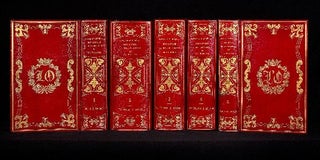
![Item ID: 11460 From title-slips on upper covers: Seken tedai katagi 世間手代氣質[Characters of Worldly Shop Clerks]; subtitle at head of title-slips: Tosei kanben 渡世勘弁 [Maneuvering Through Life]. Kiseki 江島其磧 EJIMA.](https://jonathanahill.cdn.bibliopolis.com/pictures/11460.jpg?width=768&height=1000&fit=bounds&auto=webp&v=1784029310)
![From title-slips on upper covers: Seken tedai katagi 世間手代氣質[Characters of Worldly Shop Clerks]; subtitle at head of title-slips: Tosei kanben 渡世勘弁 [Maneuvering Through Life].](https://jonathanahill.cdn.bibliopolis.com/pictures/11460_2.jpg?auto=webp&v=1784029311)
![From title-slips on upper covers: Seken tedai katagi 世間手代氣質[Characters of Worldly Shop Clerks]; subtitle at head of title-slips: Tosei kanben 渡世勘弁 [Maneuvering Through Life].](https://jonathanahill.cdn.bibliopolis.com/pictures/11460_3.jpg?auto=webp&v=1784029311)
![From title-slips on upper covers: Seken tedai katagi 世間手代氣質[Characters of Worldly Shop Clerks]; subtitle at head of title-slips: Tosei kanben 渡世勘弁 [Maneuvering Through Life].](https://jonathanahill.cdn.bibliopolis.com/pictures/11460_4.jpg?auto=webp&v=1784029311)
![From title-slips on upper covers: Seken tedai katagi 世間手代氣質[Characters of Worldly Shop Clerks]; subtitle at head of title-slips: Tosei kanben 渡世勘弁 [Maneuvering Through Life].](https://jonathanahill.cdn.bibliopolis.com/pictures/11460_5.jpg?auto=webp&v=1784029311)
![From title-slips on upper covers: Seken tedai katagi 世間手代氣質[Characters of Worldly Shop Clerks]; subtitle at head of title-slips: Tosei kanben 渡世勘弁 [Maneuvering Through Life].](https://jonathanahill.cdn.bibliopolis.com/pictures/11460_6.jpg?auto=webp&v=1784029311)
From title-slips on upper covers: Seken tedai katagi 世間手代氣質[Characters of Worldly Shop Clerks]; subtitle at head of title-slips: Tosei kanben 渡世勘弁 [Maneuvering Through Life].
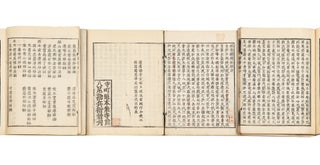
Ten double-page woodcuts. 16; 15; 15; 15; 16 folding leaves. Five vols. 8vo, orig. semi-stiff decorated wrappers, title-slips, new stitching. Kyoto: Kikuya Kihei 菊屋喜兵衛, 1730.
First edition and very rare; WorldCat lists only the Princeton copy. Ejima was one of the four most famous authors of ukiyo-zōshi novels, fashionable around 1682 to 1741. They “were romances, or often collections of stories, set in large cities (usually Edo or Osaka), recounting the lives, deeds and amorous encounters of the townsmen. They were filled with vivid detail of how people of this class lived, were usually humorous, often bawdy, and subject to frequent attack by the authorities on grounds of decency.”–Chibbett, The History of Japanese Printing and Book Illustration, p. 133.
“One of the most astute and yet understudied critics of the townsman household was Ejima Kiseki (1666-1735), a veritable exemplar of the degenerate heir that the patriarchs of the Mitsui house so feared and reviled. Born Murase Gonnojō, Kiseki was the scion of a successful Kyoto rice-cake business that dated to the dawn of the Tokugawa era. The Murase house was of the elite milieu of old families that the Mitsui document decried as undisciplined and decadent: indeed, many of Kiseki’s relatives appear in [the recollections of Kiseki’s father’s life] Chōnin kōken roku as individuals who led their families to ruin through high living and risky lending. Kiseki assumed the position of household head and the hereditary shop name of Shōzaemon in 1695, but just as he was assuming the responsibilities of a fully-fledged townsman patriarch, he was also beginning to spend his energies on activities that would ultimately come to displace his hereditary trade. A habitué of the theater and a self-styled connoisseur of Kabuki acting, Kiseki began a side career as a writer by penning a series of puppet plays for the chanter Matsumoto Jidayū that were released by the Kyoto publisher Hachimonjiya Hachizaemon (Jishō), who would become Kiseki’s ongoing patron…Over the decade or so that followed, Kiseki dedicated increasing amounts of his time and energy to his literary dalliances with actor reviews and popular fiction before making the fateful decision, in 1714, to abandon his hereditary trade and name, establishing a publishing business under the name of Ejimaya and branding his works with the pen name by which he is still known…
“The centerpiece of Kiseki’s quixotic career as a townsman dropout was Seken musuko katagi 世間子息気質(Characters of worldly young men; below, Musuko katagi), published as a flagship release for Kiseki’s Ejimaya imprint in 1715. A collection of fifteen stories in five volumes, Musuko katagi is a comic exploration of the petty vices that lead contemporary young men to disownment and ruination. The work was a major success, prompting the author to follow it with the spiritual sequels Seken musume katagi 世間娘気質 (Characters of worldly young women, 1717), Ukiyo oyaji katagi 浮世親仁形気 (Characters of old men of the floating world, 1720) and [the present work]…Later writers would continue to extend the titular trope of ‘character’ to all manner of social types and categories: mothers, mothers-in-law, mistresses, millionaires, maidservants, matchmakers, doctors, Buddhist priests and preachers, linked verse poets, theater enthusiasts, tea practitioners, shogunal bannermen, and so on. Endlessly productive and unabashedly derivative, the so-called ‘character piece’ (気質物 katagi-mono) would become the dominant genre of Kamigata popular fiction until the late eighteenth century, and would exert a profound influence on later Edo writers…
“Tedai katagi is a much less cynical work than Musuko katagi, using ingenious narrative twists to move toward conclusions that maintain the integrity of the household, albeit through the diligent and clever labors of its clerks rather than the efforts of its head.”–Thomas Gaubatz, “The Household and Its Discontents: Ejima Kiseki’s Seken musuko katagi” in Japanese Language and Literature, Vol. 59, No. 1 (April 2025), pp. 81-82 & 100.
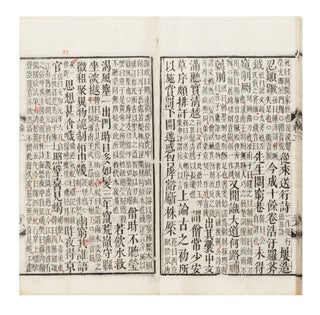
Each of the ten double-page woodcuts depicts two or more contrasting scenes: front of store and back office, street sellers and merchants in stores, an incompetent son of the owner trying to make a sale and the father lamenting, early stages of negotiation and closure, business at the pharmacy and back office, etc. They ange from proprietors of businesses to idiot sons to clever employees to lowly street sellers. Another illustration depicts the shrine of Ebisu, one of the Seven Gods of Fortune, erected in the back room of a store, bringing good fortune. We are uncertain of the artist, but Kiseki had a close relationship with Nishikawa Sukenobu 西川祐信 (1651-1751), “a prolific designer of picture-books and, because of their beauty and their wide influence, he must be considered as one of the greatest figures in the history of the Japanese book.”–Hillier, The Art of the Japanese Book, pp. 158-66. Nishikawa illustrated many books by Kiseki, and the woodcuts, to our eyes, look very much like his work.
Fine set. Seal carefully removed from blank portion of first leaf of each volume.
Price: $4,950.00
Item ID: 11460