Unpublished Manuscripts of a Taiwanese Fortuneteller
Manuscripts on paper: “Xinzhu Zhemingtang mingli chaoben” 新竹哲明堂命理抄本 [“Fortunetelling Manuscripts from the Zhemingtang Studio in Xinzhu”].
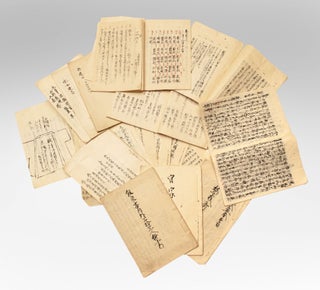
Hand-drawn diagrams, some in color. Seven vols. 8vo (varying dimensions), orig. semi-stiff wrappers (somewhat stained and rubbed) with title, date, and author names handwritten on covers, orig. stitching (one vol. knot-bound with paper cords). Hsinchu: Zhemingtang 哲明堂, 1931-60.
Seven unpublished manuscript volumes belonging to the Taiwanese fortuneteller and book collector Zheng Bingkun (zi Xiaozhong 暁鐘, studio name Zhemingtang), active in the city of Hsinchu during the period of Japanese occupation. Mostly related to traditional physiognomy and hemerology, these volumes were likely not just records kept for Zheng’s personal practice but drafts planned for print publication. These manuscripts offer a unique glimpse into the practices and clientele of Chinese divination in mid-20th century Taiwan.
The titles and contents of the seven volumes are as follows.
• Xiangli shijue 相理詩訣 [Mnemonic Poems for Physiognomy], dated xinwei (1931) on cover, signed Xiaoyaozi 逍遙子, zi Yanfei 燕飛, in Hsinchu. Knot-bound with paper cords. 47 folding leaves. Manuscript on pre-printed paper. Verses on how to interpret the “twelve palaces” (shi’ergong 十二宮) of the human face, variously correlated to longevity, wealth, marriage, career, and so on. A series of verses that follow concern the facial and physiological features of women, especially related to longevity, marriage, and childbearing. Additional verses elaborate upon the system of “twelve palaces,” explaining for example the interaction between facial features and the elements and seasons. The final third of the manuscript appears incomplete, with only the titles of the verses written in.
• Xiangfa shuji 相法樞機 [The Key to Physiognomy], signed Xiaozhong on cover. 94 folding leaves. Manuscript on pre-printed paper. A comprehensive treatise on physiognomy, including its history and principles, with several long texts detailing its practice. The second half of the volume, in multiple calligraphic styles, appears to be a personal collection of unrelated verses. Many sections have a character count handwritten beneath the title in red ink, suggesting they may have been drafts being prepared for publication.
• Ershiba xiu jie duangao shi 二十八宿解斷筶詩 [Poems on Moon Block Divination: an Explanation of the 28 Celestial Mansions], dated gengzi (1960) on cover, signed Xiaozhong. 14 folding leaves. Manuscript on ruled paper. Verses, with diagrams, on 28 categories of divination outcomes, each associated with one of the celestial mansions.
• Wuguan renxing jian 五官人形鑑 [Mirror of the Five Facial Features and the Human Form], dated Minguo 36 (1947) on cover, signed Xiaozhong. 32 folding leaves (first 30 paginated), followed by blank leaves. Manuscript on ruled paper. A fascinating collection of 63 physiognomic cases, likely records of the author’s clients. The name, date and place of birth, and date of reading is recorded for each client, as well as versified readings of their five facial features (brows, eyes, ears, mouth, and nose) and overall physique. Most of the readings were taken in 1947, while a few toward the end of the manuscript are dated as early as 1940 and as late as 1957. Many of the clients were born in Hsinchu, but some were born in other cities in Taiwan such as Taipei and Tainan. The card of Wu Huihuang 吳輝煌, a client who was also a candidate for the Hsinchu congressional election, is laid in next to his physiognomic reading, between ff. 29 and 30.
• Wuxing chandu liunianjue 𠄡星剗度流年訣 [Manual of Hemerological Calculations Around the Five Planets]. Signed Zhemingtang on cover. Six folding leaves, followed by many blank leaves. Manuscript on ruled paper. A handful of elaborate and colorful hemerological charts, which was the art of traditional date selection based on complex astrological calculations. The charts are filled in with conventional and Suzhou numerals, the 24 solar terms, and the various day-gods with inks of multiple colors, including black, red, lavender, blue, and cyan.
• Shaozi shenshu 邵子神數 [Sacred Numerology of Master Shao]. Dated gengchen (1940) on cover, signed Zhemingtang. 55 folding leaves. Manuscript on ruled paper. Chart of divination readings, following a numerological system attributed to Shao Yong 邵雍 (1011-77). The 244 readings are divided into 12 categories of inquiry (such as illness, pregnancy, wealth, names, lawsuits), and each reading is given both a poetic reading and a practical explanation.
• Baihe xianshu 白鶴僊數 [Immortal Numerology of the White Crane]. Dated renwu (1942] on cover, signed Zhemingtang. 48 folding leaves. Manuscript on ruled paper, with a handwritten title-page. Illustrated manual of hand reading, focusing on interpreting the lengths and proportions of the fingers. Each folio explains one hand shape, beginning with its name and illustration on upper recto, with a long explanation in lower recto and verso of the fate of those having these finger dimensions.
The volumes are in good reading condition. The wrappers are somewhat stained and rubbed, and the texts are lightly foxed and sometimes stained around the margins. Bell-shaped red seal reading 新竹/哲明堂/鄭曉鐘 appears throughout.
Price: $6,500.00
Item ID: 11427