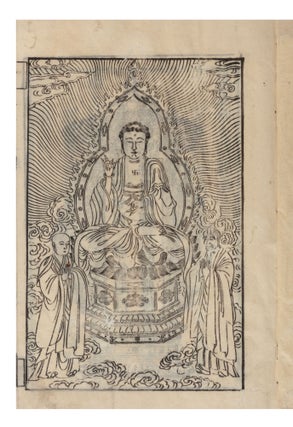
![Item ID: 11425 Dili jiyao 地理輯要 [The Essentials of Geology]. Peng 余鵬 YU.](https://jonathanahill.cdn.bibliopolis.com/pictures/11425.jpg?width=768&height=1000&fit=bounds&auto=webp&v=1785866347)
Dili jiyao 地理輯要 [The Essentials of Geology].
Woodblock-printed. With woodcut illustrations of geological formations. 6, 31, 26 (duplicate of f. 13 bound after f. 14), 17, 20; 31, 34, 33, 34 folding leaves. Introductory juan and 7 numbered juan in two vols. 8vo (226 x 145 mm.), plain paper wrappers, old stitching. [China]: Guihua lou 桂華樓 (title-page), Preface dated 1751.
First edition of the anthology of canonical texts within the Chinese geological tradition (dili 地理; kanyu 堪輿; fengshui 風水) by Yu Peng 余鵬 (zi Puyuan 樸園), together with his commentary. This is a very rare book: we locate only two other copies, both in China.
The study of geology (Needham uses “geomancy”) in traditional China combined the technical analysis of landscape and waterway formations — described through an eclectic jargon including “dragon veins” (long 龍) and “acupoints” (xue 穴), “eminences” (sha 砂) and “waterways” (shui 水) — with the human concern of constructing appropriate dwellings for the living and the dead. Choosing a site for any architectural construction — from family homes and ancestral graveyards to imperial palaces and mausoleums — required the careful observation of its surroundings, so that the natural and built environments complemented each other harmoniously. By interpreting the anatomy of large-scale mountain ranges (the “dragon veins”) and rivers (the “waterways”), the geologist, much like a physician, skillfully locates the “acupoints” wherein the landscape’s energetic flows concentrate in ways suitable for human dwelling, and refines the position and facing of the architectural construction by further investigating the local terrain (the “eminences”).
"Of all the forms of divination, geomancy was perhaps that which became most deeply rooted in Chinese culture throughout the traditional period. It led to a minute appreciation of the topographical features of any locality, the forms of the hills and the directions and windings of the streams, the presence of woods and flooded rice-fields, the building of pagodas on conspicuous eminences and the contours of city walls. A wealth of technical terms, as yet very imperfectly understood, was applied to the configurations of terrain, connecting together in many varying ways the Yang and the Yin, the dragon and tiger, the earth, planets and stars...Purely superstitious though in many respects they sometimes became, the system of ideas as a whole undoubtedly contributed to the exceptional beauty of positioning of farmhouses, manors, villages and cities throughout the realm of Chinese culture.”-Joseph Needham, Science and Civilization in China, Vol. 4.1, p. 240 (see also Vol. 2, pp. 359-62).
The Essentials of Geology is an edited selection of texts that introduces this tradition, emphasizing the so-called Formalist (xingshipai 型勢派) approach, which focuses on concrete geological formations rather than metaphysical calculations. The “general introduction” (zonglun 總論) of Ye Tai 葉泰 (1652-1712, court geologist of the Qing) defines the tenets of geological theory, from the correspondence between landscape and celestial constellations (xingchen 星辰) to such ideas as “living pneuma” (shengqi 生氣), “four falls and five knots” (siluo wujie 四落五結), and “upper and lower eminences” (shangxiasha 上下砂). Many illustrations supplement Ye Tai’s text, which is followed by a mnemonic song, apparently composed by Yu Peng, on the transformation of peaks into acupoints (bianxue ge 變穴歌).
The seven numbered juan consist of excerpts from canonical texts such as the Scripture on Burial (Zangjing 葬經) by Guo Pu 郭璞 (276-324), the Scripture of Jade Marrow (Yusui jing 玉髓經) by Zhang Ziwei 張子微 (fl. 10th century), and the Dragon-Shaking Scripture (Hanlong jing 撼龍經) of Yang Yunsong 楊筠松 (834-900), accompanied by original illustrations and commentary. The final juan returns to the writings of Ye Tai and is dedicated to the use of the many-layered magnetic compass (luojing 羅經), the most important (and complex) tool used in geological practice.
The title page gives the publisher as Guihua lou 桂華樓, and “Jukui tang” 聚奎堂 (likely the name of Yu Peng’s studio) appears on the woodblock centers. The Preface by Wen Yangmo 文颺謨 is dated Qianlong xinwei (1751), followed by the Preface of Yu Peng, dated the same year.
The Essentials of Geology is not included in the recently published anthology of Chinese traditional divination manuals (Shuzang 術藏: Jiuzhou chubanshe, 2009), whose kanyu category includes over a hundred titles from collections worldwide. WorldCat lists only the modern reprint, and we locate only two other early copies: one held at the National Library of China, in the same edition as ours, and the other a manuscript held at the Shanghai Library.
Very good condition, with light worming and staining. Preserved in a hantao, on the interior of which is a label that reads “福元盛雜貨莊 / 宣化南街.”
❧ Andrew L. March, “An Appreciation of Chinese Geomancy,” Journal of Asian Studies 27, no. 2 (1968): pp. 253-67.
Price: $5,500.00
Item ID: 11425