![Item ID: 11252 Manuscript copy of Cho’s Chungbong Sŏnsaeng chip 重峯先生集 [Collected Writings of Chungbong]. Hŏn 趙憲 CHO.](https://jonathanahill.cdn.bibliopolis.com/pictures/11252.jpg?width=768&height=1000&fit=bounds&auto=webp&v=1776800048)
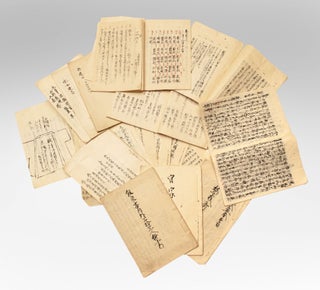
Manuscript copy of Cho’s Chungbong Sŏnsaeng chip 重峯先生集 [Collected Writings of Chungbong].
Manuscript on preprinted paper. 72.5; 57; 52.5; 80 folding leaves. Five numbered kwŏn & purok in four volumes. Large 8vo, orig. semi-stiff wrappers, handwritten title on upper covers, new stitching. [Korea]: [after 1666].
A fine Korean manuscript of the collected works of the martyr Cho Hŏn (alias Chungbong, 1544–92), remembered for his heroic sacrifice during the Imjin War of 1592. These collected works were first published in a woodblock edition in 1666. Pre-1910 copies of this work are very rare: we find only three copies in WorldCat, all woodblock-printed, held at UC Berkeley (Asami Library 39.47), Harvard, and Columbia.
“Today, in Kŭmsan County, Chungcheongnam-do, South Korea, the site known as the Ŭich’ong [Tomb of the Martyrs] still remains — a memorial to the seven hundred soldiers who fought against the Japanese forces during the Imjin War (1592) and died in battle with unwavering loyalty. Cho Hŏn raised more than 1,700 volunteer troops in Okch’ŏn and, joining forces with Yŏnggyu 靈圭 (?-1592), a Buddhist monk who led a righteous army, succeeded in recapturing Ch’ŏngju. He then fought at Kŭmsan with seven hundred remaining soldiers, resisting the Japanese army until they all perished heroically. After their deaths, Cho’s disciples Pak Chŏng-nyang and Chŏn Sŭng-ŏp gathered the bodies and buried them together — this became the Seven Hundred Righteous Tombs,”–Hyok key Song, “Ŭich’ong 義塚: Shaping the Memory of War,” Journal of Sinographic Philologies and Legacies 1, No. 4 (2025), p. 108.
While accounts of Cho’s military activities by his contemporaries varied, probably due to factional biases, by the early 17th century, with the rise to power of the “Western” faction, the sacrifices of Cho and his volunteer army became the subject of numerous commemorative stele inscriptions, prose narratives, and illustrated albums, culminating in the bestowal of his posthumous title, Munnyŏl-gong 文烈公, in 1649 (ibid.).
Cho’s collected writings were compiled by An Pang-jun 安邦俊 (1573-1654) on the basis of family-held manuscripts. “An Pang-jun devoted his life to investigating and recording the deeds of righteous army figures…An Pang-jun himself participated in righteous army activities during the Imjin War at a young age and continued to raise volunteer forces whenever the state faced crisis, including during the Manchu invasions, thus putting into practice the very ideal of chŏlŭi [resolute loyalty] that he revered” (ibid., p. 121). The collected writings An compiled first appeared in a woodblock publication in 1666, in five kwŏn with one kwŏn of purok or appendix. The first kwŏn contains Cho’s poetry, the second kwŏn his essays, the third kwŏn his letters, and the last two kwŏn memorials and documents related to his military activities. The appendix contains various memorial and laudatory texts composed by later scholars.
Our copy agrees, in both structure and content, with this first edition of Cho’s collected writings, and not the 1748 Kyosŏgwan edition. The table of contents of the main anthology is bound in our copy in the fourth volume, immediately after the table of contents of the appendix. The text is written in a charming, slightly cursive style, onto pages preprinted with grids characteristic of woodblock-printed books. Si-Nae Park, a scholar of Korean book history, writes that “Privately conducted commercial transactions of books co-existed with gifting, loaning, and scribal duplication. It was a common practice for novice learners to make handwritten copies of the classics and canon. Moreover, late Chosŏn literati frequently copied the whole book or just epitomes (ch’o) of a book not only for learning and reading but also for building a private book collection” (Park, “Manuscript, not Print, in the Book World of Chosŏn Korea,” in Routledge Companion to Korean Literature, 2022).
Fine fresh set, with occasional marginal ink and water staining. A paper slip pasted in the back endpaper of Vol. 2 dates the copying of the text to a kyŏngja year, the earliest of which possible for this work would be 1720. A very rare work: we find fewer than 10 premodern copies in total in WorldCat and KORCIS, the union catalogue of rare books in Korea.
Price: $5,000.00
Item ID: 11252