![Item ID: 11236 Hyōdai kukai Kōshi kego 標題句解孔子家語 [C. Kongzi jiayu; Traditional Sayings of Confucius] & other works (see below). FUSHIMI BAN 伏見版.](https://jonathanahill.cdn.bibliopolis.com/pictures/11236.jpg?width=768&height=1000&fit=bounds&auto=webp&v=1770233420)
![Hyōdai kukai Kōshi kego 標題句解孔子家語 [C. Kongzi jiayu; Traditional Sayings of Confucius] & other works (see below).](https://jonathanahill.cdn.bibliopolis.com/pictures/11236_2.jpg?auto=webp&v=1770233420)
![Hyōdai kukai Kōshi kego 標題句解孔子家語 [C. Kongzi jiayu; Traditional Sayings of Confucius] & other works (see below).](https://jonathanahill.cdn.bibliopolis.com/pictures/11236_3.jpg?auto=webp&v=1770233420)
![Hyōdai kukai Kōshi kego 標題句解孔子家語 [C. Kongzi jiayu; Traditional Sayings of Confucius] & other works (see below).](https://jonathanahill.cdn.bibliopolis.com/pictures/11236_4.jpg?auto=webp&v=1770233420)
![Hyōdai kukai Kōshi kego 標題句解孔子家語 [C. Kongzi jiayu; Traditional Sayings of Confucius] & other works (see below).](https://jonathanahill.cdn.bibliopolis.com/pictures/11236_5.jpg?auto=webp&v=1770233420)
![Hyōdai kukai Kōshi kego 標題句解孔子家語 [C. Kongzi jiayu; Traditional Sayings of Confucius] & other works (see below).](https://jonathanahill.cdn.bibliopolis.com/pictures/11236_6.jpg?auto=webp&v=1770233420)
![Hyōdai kukai Kōshi kego 標題句解孔子家語 [C. Kongzi jiayu; Traditional Sayings of Confucius] & other works (see below).](https://jonathanahill.cdn.bibliopolis.com/pictures/11236_7.jpg?auto=webp&v=1770233420)
“Fushimi-ban Are Also Considerable Works of Art”–Chibbett
Hyōdai kukai Kōshi kego 標題句解孔子家語 [C. Kongzi jiayu; Traditional Sayings of Confucius] & other works (see below).
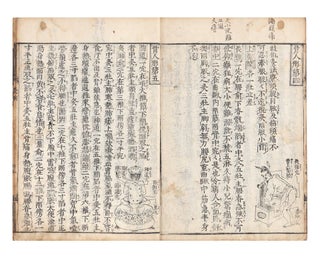
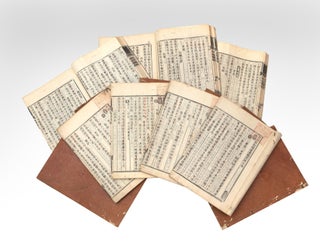
Full-page woodcut port. of Confucius & diagrams in Vol. III. 61; 53; 92 folding leaves. Three vols. Large 8vo (281 x 198 mm.), orig. semi-stiff wrappers, orig. title-slips, new stitching. From colophon at end of Vol. III: Fushimi: Jigen 慈眼, 1599.
The first printed Fushimi ban edition; like all editions from this press, this is an extremely rare book, and WorldCat lists only one copy, at Columbia. Fushimi ban books, printed with wooden movable type, were created at the printing works at Fushimi, Kyoto, which had been established by Ieyasu (1542-1616), the first shogun of the Edo era. Genkitsu 元佶 (1548-1612), the ninth head of the famous Ashikaga Gakkō center of learning, was appointed to oversee the production, which resulted, between 1599 and 1606, in eight books created with wooden movable type, of which this is the first.
“These Fushimi-ban are also considerable works of art, but because of the small typeface used in them, they do not have quite the same opulent effect as the choku-han.”–David Chibbett, The History of Japanese Printing and Book Illustration (1977), p. 71.
Ieyasu, the bookish military leader and shogun, had been long interested in printing. The introduction of typography in the 1590s in Japan, from both Korea and Europe, rekindled his interest. “In 1599 Ieyasu ordered 100,000 pieces of wooden type to be cut and he gave these to…Genkitsu (1548-1612; also known as San’yō [三要]), a Zen monk whom Ieyasu had placed in charge of the Enkōji [円光寺] temple in Fushimi. There Genkitsu printed a number of books [eight in total] using this wooden movable type. With the exception of the Azuma kagami (1605), these were all Chinese works, and they consisted of the following: [the present work], a collection of sayings attributed to Confucius and his followers; San lue (1599), one of the two military texts included in the list of Ieyasu’s favourite books; Zhen-guan zheng yao (1600), which Seika had lectured to him on and which was to remain an important text in his eyes; Classic of Changes (Zhou yi, J. Shūeki, 1605); and Qi shu (J. Shichisho, 1606), a collection of seven early military texts. To what extent Ieyasu was directly involved in the selection is not entirely clear. Genkitsu states in the colophon of [the present work] that Ieyasu had achieved renown both by arms and by learning and, wanting to restore what had fallen into decay, had given him the type to print works for the benefit of later generations; also, several of the colophons to the other works state that they had been printed at Ieyasu’s orders. If this is true, then it might well be that Ieyasu dictated which books were to be printed; after all, several of them are works that, as we have seen, were said to have been among his preferred books.”–Kornicki, “Books in the Service of Politics: Tokugawa Ieyasu as Custodian of the Books of Japan” in Journal of the Royal Asiatic Society, Third Series, Vol. 18, No. 1 (Jan. 2008), p. 75.
In Vol. III are two appended works: 素王事 紀 and 聖朝通制孔子廟祀, the former reproducing the date of the original Chinese edition, 泰定甲子 (1324), at the end of its index. The fine woodcut portrait of Confucius precedes the text of the first appended work. The diagrams that follow depict family trees, correct placements of foods on altars and tables during rituals, and palace grounds.
PROVENANCE: two private collectors, one in New Jersey, the second in France.
A fine fresh set preserved in a wooden box. Minor worming, well restored.
❧ K.G. Gardner, Descriptive Catalogue of Japanese Books in the British Library Printed before 1700 (1993), 26. Kornicki, The Book in Japan (1998), p. 130.
Price: $95,000.00
Item ID: 11236
![Catalogue des Livres provenans de la Bibliotheque de M.L.D.D. L. V. [Duc de la Vallière]. AUCTION CATALOGUE: LA VALLIÈRE.](https://jonathanahill.cdn.bibliopolis.com/pictures/2943.jpg?width=320&height=427&fit=bounds&auto=webp&v=1475847348)