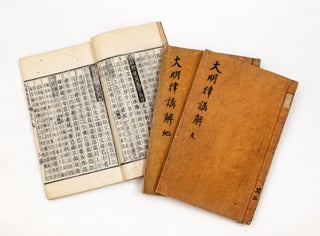
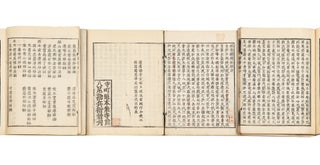
![Item ID: 11168 Wakan senyō shū 和漢船用集 [Encyclopedic Study of Japanese & Chinese [& Korean and Other Asian & Western] Ships]. Kanemitsu 金澤兼光 KANAZAWA.](https://jonathanahill.cdn.bibliopolis.com/pictures/11168.jpg?width=768&height=1000&fit=bounds&auto=webp&v=1770151210)
“Well-Illustrated & Containing Much of Interest”–Needham
Wakan senyō shū 和漢船用集 [Encyclopedic Study of Japanese & Chinese [& Korean and Other Asian & Western] Ships].
Many double-page & full-page woodcuts throughout. 12 vols. 8vo, orig. pale blue semi-stiff wrappers, most title-slips absent, new stitching. Osaka: Fujiya Tokubei 藤屋徳兵衛 & Edo: Suharaya Mohei 須原屋茂兵衛, 1827.
Second edition (1st ed.: 1766) of the “first treatise on the history and technology of ships in Japan…[It] was written in 1761 and published five years later by Kanemitsu Kanazawa, who came from a family in Osaka with a long shipwrighting tradition. In the introduction of this treatise, the author explains that he used the documents which his ancestors had collected for two hundred years. The treatise consists of 12 volumes and about 560 pages. Approximately 150 references to ships from ancient sources are cited. This work comprehensively treats all watercraft from logboats to contemporary ships, with a section about carpentry and shipwright tools. Wakan Senyo Shu is indispensable for the study of Japanese ships and technologies of its time.”–Hiroaki Miyashita, “Ancient Ships of Japan,” Texas A&M University, Master of Arts thesis (August 2006), p. 8.
As revealed by the table of contents in Vol. I, the detail the author has provided regarding old and contemporary ships and shipbuilding is quite incredible. It deals with traditional shipbuilding techniques, the various types and uses of ships, the woods used and the tools employed, the ornaments that adorned the ships, the number of men required to build and sail the various ships, precise measurements and dimensions (including details about how many koku of rice could be transported), etc.
The author describes the religious aspects of shipbuilding, explaining that the gods were necessary to protect ships and their sailors. Many varieties of Chinese, Korean, Ryukyu Kingdom, Thai, Dutch, English, Philippine, and Japanese ships and boats are described and portrayed in the numerous fine woodcut illustrations. The author also describes regional styles of ships of China and Japan. The range of boats and ships is large, from little rafts to cross rivers, larger fishing boats to enormous freight-carrying and military ships.
The illustrations are extremely detailed, showing shipwrights at work, with their tools well portrayed. The enormous range of fastening devices, including nails, is described and illustrated in Vol. 10. Vol. 11 is devoted to the variety of masts, ropes (made from human hair, vines, bamboo skin, cedar bark, palm fibers, or paper, etc.), anchors, winches, oars, flooring, fireproof cooking vessels, water barrels, pumps, mats, flags, and compasses. The final volume is devoted to shipwrighting tools, depicting the wide range of instruments used (saws, chisels, hand planes, knives, sharpening stones, etc.).
The author even describes tiny ships made of paper (origami) used for rituals and entertainment, and considers bamboo leaves and clam shells floating in water as sorts of ships. One of the large ships illustrated is a floating public bath.
Fine fresh set; both the first edition and the second editions are extremely rare (there is no copy of our second edition located outside of Japan). A few volumes have minor marginal worming. Preserved in a chitsu.
❧ Needham et al., “Civil Engineering and Nautics” (Vol. 4, Part III) in Science and Civilisation in China, p. 402n.f–“well-illustrated and containing much of interest.”.
Price: $27,500.00
Item ID: 11168
![In Japanese, first line]: Issai nyorai shin himitsu zenshin shari hokyoin darani. SUTRA KŌFUKUJI 興福寺 PRINTING.](https://jonathanahill.cdn.bibliopolis.com/pictures/11486.jpg?width=320&height=427&fit=bounds&auto=webp&v=1786387827)