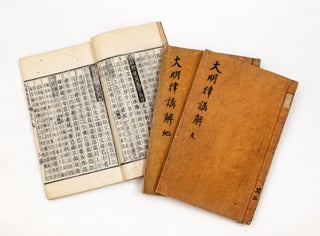
![Item ID: 11111 [Regulations for Preventive Detention of Ideological Criminals]. CHŌSEN SHISŌHAN YOBŌ KŌKIN REI 朝鮮思想犯予防拘禁令.](https://jonathanahill.cdn.bibliopolis.com/pictures/11111.jpg?width=768&height=1000&fit=bounds&auto=webp&v=1769703196)
![[Regulations for Preventive Detention of Ideological Criminals].](https://jonathanahill.cdn.bibliopolis.com/pictures/11111_2.jpg?auto=webp&v=1769703196)
![[Regulations for Preventive Detention of Ideological Criminals].](https://jonathanahill.cdn.bibliopolis.com/pictures/11111_3.jpg?auto=webp&v=1769703196)
“Classified”
[Regulations for Preventive Detention of Ideological Criminals].
20; 45.5; 9.5; 6.5; 2.5; 2 folding leaves. Six parts in one vol. 8vo (260 x 185 mm.), orig. printed self-wrappers, stapled. [Korea]: before Autumn 1940, probably late 1939-early 1940.
A fascinating printed government document, stamped on upper wrapper with a seal (“Gokuhi” 極秘) indicating this was a classified document.
During Japan’s colonization of Korea (1910-45), the occupiers installed a newly centralized and effective police apparatus, which included a massive influx of Japanese military and police. The suppression of nationalists, dissidents, religious leaders, and anarchists was severe. With Japan’s occupation of Manchuria and its growing war effort, the ruling Governor-General began to shut down Korean organizations of all types. A powerful secret police force, including the Japanese military police (Kempeitai), and a network of informants enabled systematic crackdowns on political dissent. Torture, forced confessions, and executions of those considered a significant threat to the Japanese colonial government were widely reported. A series of infamous prisons, most notably the Seodaemun in Seoul, were sites of interrogation and punishment.
This document, issued by the powerful Japanese Governor-General of Korea’s legal section, was based on the 1925 Chian iji hō (治安維持法, “Peace Preservation Law”), which allowed elite police in Japan to effectively suppress alleged socialists, communists, and others critical of the government and capitalist system developing on the island nation. It reprints the 1925 law and the plans to establish a version of the same law in Korea.
The text provides a revealing chart with statistics of political prisoners, the number successfully “converted,” the number of “failures,” number of death sentences, executions, other deaths, those released, etc., for the years 1934-39.
Another chart lists public “incidents” and their nature, number of resulting detainees, the names of the leaders, sentences issued by the Japanese courts, etc., between 1930 and 1939. Also listed are the six prisons where political prisoners were incarcerated: Daegu 大邱, Seodaemun 西大門, Chonju 全州, Gyeongseong 京城, Hamhung 咸興, and Haeju 海州.
Two parts are concerned with the laws for prison guards and prisoners in the incarceration centers.
In fine condition.
Price: $2,500.00
Item ID: 11111