
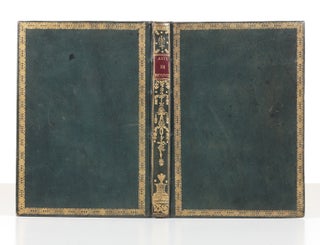
![Item ID: 10948 Shang han lun zhu lai su ji 傷寒論註來蘇集 [A Collection of Resuscitation: Commentary on the “Treatise on Cold Damage”]. Qin 柯琴 KE.](https://jonathanahill.cdn.bibliopolis.com/pictures/10948.jpg?width=768&height=1000&fit=bounds&auto=webp&v=1748636105)
His Magnum Opus
Shang han lun zhu lai su ji 傷寒論註來蘇集 [A Collection of Resuscitation: Commentary on the “Treatise on Cold Damage”].
1755. Six vols. 8v0, later wrappers, new stitching. Kunshan: Suifu tang 綏福堂, 1755.
Probably the first edition of the commentary by Ke Qin (fl. 17c.–18c., aliases Yunbo 韻伯, Sifeng 似峰) on the Treatise on Cold Damage of the third-century Chinese physician, Zhang Zhongjing 張仲景. “Ke [was] acknowledged as one of the most sagacious readers of the Treatise of all times…Ke’s three-volume exegesis of the Treatise was re-printed over thirty times in the subsequent two hundred and fifty years, attesting to its status and enduring influence on writers and physicians throughout China and East Asia.”–Volker Scheid, “Transmitting Chinese Medicine,” Asian Medicine 8.2, p. 336.
The scholar and physician Ke Qin belongs to a lineage of Chinese medical practitioners who, since the 16th century, sought to revise and rearrange the Treatise on Cold Damage — the third-century treatise that laid the theoretical and practical foundation for traditional Chinese medicine as we know it — in accordance with the realities of their own clinical experiences. Rather than treating the ancient treatise as a text to be revered and commented upon, Ke approached it as a living system of medical knowledge organized, on the one end, around the “six channels” (liujing 六經) of the human body and, on the other end, around the plethora of actual medical prescriptions and remedies. As he states in his Preface, “the spirit of the author [of the Treatise] is outside language and writing,” and it was therefore more important to capture the essence of the original teachings rather than adhere (as many have done) closely to the text. “The Way of Zhongjing [i.e., Chinese medicine] is as simple and clear as it gets, and its gate of entry can be entered by anyone whosoever.” This collection of commentary and appendices to the Treatise aspired precisely to make this ease of entry manifest.
The work is divided into three parts, each bearing a separate title: Shang han lun zhu 傷寒論註, in four juan, is a commentary on the Treatise that has been re-arranged on the basis of distinctive presentations and their remedies (fang zheng 方證); Shang han fu yi 傷寒附翼, in one juan, explains the system of pharmacological principles behind various treatments associated with each of the six channels; and finally, Shang han lun yi 傷寒論翼, in three juan, essays on etiology, pathology, and various symptoms and disorders arising from imbalances in the channels as well as their interactions with each other. Together, A Collection of Resuscitation (the title is a reference to the Classic of Documents, recalling the resuscitation of a people in hardship upon the arrival of a virtuous prince) constitutes an invaluable archive not only of historical medical remedies and healing practices, but also of how practical medicine embraced other systems of knowledge such as human anatomy, herbology, and cosmology.
Scholarly disagreements persist regarding Ke Qin’s dates and the history of the early editions of his magnum opus because, for what some suspect to be political reasons, Ke signed his Prefaces using only the sexagenary cycle, without specifying the reign name. The first part of the work, he wrote in his Prefaces, was completed between bingwu 丙午 and jiyou 己酉, while the third part was completed in jiayin 甲寅. As recently as 2023, in a collection of essays dedicated to Ke Qin published in China, contributors still diverge on whether the two completion dates correspond to 1729/1734 or to a cycle earlier, 1669/1674. They refer to a range of external sources that shed light on Ke’s biography, and it becomes clear that those sources themselves have irreconcilable contradictions.
These ambiguities notwithstanding, our 1755 edition, proofread and published by Ma Zhonghua 馬中驊 in Suifu tang, is generally held to be the first major (and earliest extant) printing of the work containing all three texts, and is the standard basis of its subsequent reprints and modern editions. Interestingly, Ma himself has glossed the sexagenary year name in Ke’s first Preface as being from the Yongzheng reign (1722–35). It is nevertheless clear that some parts of the work, especially Shang han lun yi, had been circulating well before 1755 in either manuscript or print among contemporary Suzhou physicians such as Luo Mei 羅美 (n.d., Kangxi period) and Ye Gui 業桂 (1667–1747).
A handwritten note on the last page of the last volume states that the book was purchased in Daoguang 9 (1829).
Fine set, preserved in a hantao. Title in first volume strengthened, and minor dampstaining, mostly marginal, in final volume.
❧ Guojia zhongyiyao guji shuzi tushuguan 國家中醫藥古籍數字圖書館. http://www.cintcm.com/. Xu Junhua 徐俊華 and Ge Huinan 葛惠男, eds., Ke Qin yanjiu wenji 柯琴研究文集 (Shanghai shiji: 2023). Xuxiu Siku quanshu zongmu tiyao zibu 續修四庫全書總目提要子部 (Shanghai guji: 2015), pp. 140–41.
Price: $12,500.00
Item ID: 10948


![Shozaishu 匠材集 [Dictionary of Renga Poetry [or] Collection of Building Materials. Joha 里村紹巴 SATOMURA.](https://jonathanahill.cdn.bibliopolis.com/pictures/6999.jpg?width=320&height=427&fit=bounds&auto=webp&v=1588723281)
