![Item ID: 10662 Paeksa sŏnsaeng pukch’ŏn illok 白沙先生北遷日錄 [Master Paeksa’s Record of Banishment to the North]. Ch’ong-sin 鄭忠信 CHŎNG.](https://jonathanahill.cdn.bibliopolis.com/pictures/10662.jpg?width=768&height=1000&fit=bounds&auto=webp&v=1732694435)
![Paeksa sŏnsaeng pukch’ŏn illok 白沙先生北遷日錄 [Master Paeksa’s Record of Banishment to the North].](https://jonathanahill.cdn.bibliopolis.com/pictures/10662_2.jpg?auto=webp&v=1732694435)
Paeksa sŏnsaeng pukch’ŏn illok 白沙先生北遷日錄 [Master Paeksa’s Record of Banishment to the North].
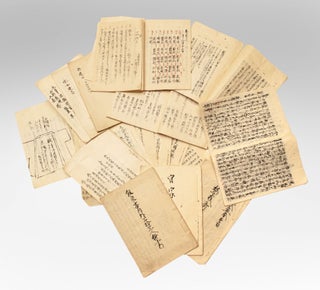
1686. 47 folding leaves. Woodblock printed. Large 4to (322 x 212 mm.), orig. semi-stiff wrappers (a little worn and wormed), old stitching. [Korea]: 1686 (date of Preface).
A record of exile and a product of factional strife in Chosŏn Korea. Factionalism plagued the Chosŏn court for much of the dynasty’s existence, including during the reign of the monarch who came to be known simply as Kwanghaegun (r. 1608-23), or Prince Kwanghae. The Westerners, Northerners, and Southerners vied for power as Korea was recovering from the Japanese invasion and facing Ming Chinese pressure to resist the Jurchens, the future Manchu rulers of China.
“King Kwanghaegun (r. 1608–23), who had ascended the throne with Northerner support upon the sudden death of his father, Sŏnjo, sought to keep war-devastated Chosŏn out but ultimately succumbed to the Ming demand and the pressures of his officials. Kwanghaegun dispatched to Liaodong a force of about 10,000 musketeers and 3,000 archers under Kang Hongnip (1560–1627), instructing him to do his best not to engage the Later Jin forces but also to respond according to the tide of the conflict. In a series of clashes, the combined Ming-Chosŏn army of between 103,000 and 133,000 suffered a crushing defeat by about 60,000 Later Jin troops, and Kang surrendered with 7,000 survivors (1619). Subsequently, Ming continued to request more troops, but Kwanghaegun declined. In the interim, the powerful Northerners dominated officialdom until the Westerners staged a coup, deposed the king, and purged the Northerners (1623)” (Park, p. 173).
One of the actions taken by the Northerners during their dominance of court politics was to strip Queen Inmok — the mother of an already deposed, exiled, and executed prince — of her titles. Yi Hang-pok 李恒福 (1556-1618, style name Paeksa), opposed this move, for which he too was exiled. Chŏng Ch’ong-sin, the author of our book, accompanied Yi into exile and wrote his account of these events.
Our book is beautifully printed, with a Preface (by Nam Ku-man 南九萬 [1629-1711], dated 1686) and a colophon (by Yi Min-sŏ 李敏敍 [1633-88], dated the same year) in striking calligraphy. There are also three leaves of reproduced calligraphy by Yi Hang-pok.
Fine copy, very minimal marginal dampstaining; preserved in a new hantao.
❧ Eugene Y. Park, Korea: A History (Stanford: 2022).
Price: $5,500.00
Item ID: 10662