![Item ID: 10372 Ma. Manju monggo nikan ilan acangga šu-i tacibure hacin-i bithe; Mo. Manǰu mongγol kitad γurban neičetü udq-a-yin surγaqu ǰüil-ün bičig; Ch. Man Meng Han san wen he bi jiao ke shu 滿蒙漢三文合璧教科書 [Textbook in the Three Juxtaposed Languages of Manchu, Mongolian, & Chinese]. Weiqiao 蔣維喬 JIANG, Yu 莊俞 ZHUANG, authors, trans ŽUNGDE 榮德, or RONGDE.](https://jonathanahill.cdn.bibliopolis.com/pictures/10372.jpg?width=768&height=1000&fit=bounds&auto=webp&v=1722449679)
![Ma. Manju monggo nikan ilan acangga šu-i tacibure hacin-i bithe; Mo. Manǰu mongγol kitad γurban neičetü udq-a-yin surγaqu ǰüil-ün bičig; Ch. Man Meng Han san wen he bi jiao ke shu 滿蒙漢三文合璧教科書 [Textbook in the Three Juxtaposed Languages of Manchu, Mongolian, & Chinese].](https://jonathanahill.cdn.bibliopolis.com/pictures/10372_2.jpg?auto=webp&v=1722449679)
![Ma. Manju monggo nikan ilan acangga šu-i tacibure hacin-i bithe; Mo. Manǰu mongγol kitad γurban neičetü udq-a-yin surγaqu ǰüil-ün bičig; Ch. Man Meng Han san wen he bi jiao ke shu 滿蒙漢三文合璧教科書 [Textbook in the Three Juxtaposed Languages of Manchu, Mongolian, & Chinese].](https://jonathanahill.cdn.bibliopolis.com/pictures/10372_3.jpg?auto=webp&v=1722449679)
Manchu & Mongolian for a New Era
Ma. <i>Manju monggo nikan ilan acangga šu-i tacibure hacin-i bithe</i>; Mo. <i>Manǰu mongγol kitad γurban neičetü udq-a-yin surγaqu ǰüil-ün bičig</i>; Ch. <i>Man Meng Han san wen he bi jiao ke shu</i> 滿蒙漢三文合璧教科書 [<i>Textbook in the Three Juxtaposed Languages of Manchu, Mongolian, & Chinese</i>].
Ten vols. 8vo, orig. wrappers, old stitching. [China]: 1909-12.
An important, one-of-a-kind trilingual textbook. In 1905, the Qing government took the radical move to abolish the civil service examinations, which had been contested for a long time and reformed in 1901. Rather than a system of examinations supported by schools preparing students for the lowest level of the exams, the court instituted a tiered system of schools, from elementary to advanced, with students across the country using new textbooks. Our book is a product of the extension of this new educational regime to “present-day” Inner Mongolia.
One of the two textbooks chosen for the new Chinese schools — and the most popular — was Zuixin chudeng xiaoxue guowen jiaokeshu 最新初等小學國文教科書 [The Up-to-Date National Language Reader for Lower Primary Schools], which Jiang Weiqiao (1873-1958) and Zhuang Yu (1878-1940) published in 1905 with the Commercial Press in Shanghai. Jiang was a low-level examination graduate who had been exposed to Western learning through the publications of the Jiangnan arsenal. After a first career as a teacher in new-style schools, he entered the translation department at the Commercial Press in 1903, where he planned and wrote many of the textbooks that the press published. His later career was spent in education administration at the national, provincial, and university levels. Zhuang was trained in geography and entered the Commercial Press on Jiang’s recommendation. He too later worked in school administration while continuing to write textbooks.
The purpose of Jiang and Zhuang’s book was, as they explained in the Preface, to “provide everyone basic moral values and knowledge and enable them to learn about important thoughts of ancient sages and academics, arts, and skills of all countries in the world.” Like others in the genre, this book “touched on a wide range of topics, such as science, history, geography, and civics” and included “the newest terms concerning every subject at the time and reflected the most recent findings of scholars” (He, pp. 100-01).
As the Qing government attempted to bring the empire’s Inner Asian possessions closer to China proper in the face of foreign aggression, new schools were instituted in parts of Inner Mongolia. What textbooks to use presented a problem. Ungde (or Rongde), who was appointed as honorary supervisor of the Fengtian Mongolian Language School in what is now the city of Shenyang, was aware of this issue. Ungde also taught Mongolian at the school. He noted that the school used Gao E’s 高鶚 Lizhi jiyao 吏治輯要 [Essentials of Administrative Discipline], which Tongšui 通瑞 had translated into Manchu, and Meng boo 夢保 in turn translated into Mongolian. Gao’s text had been written sometime before his death in 1814, and it was not a textbook fit for molding an informed citizenry in the early 20th century. Ungde therefore decided to translate Zuixin chudeng xiaoxue guowen jiaokeshu into Mongolian.
Mongolia had traditionally been administered in the two languages of Mongolian and Manchu, the Qing dynastic language, and not in Chinese. Accordingly, most of the Mongolian pedagogical literature that circulated in China — as opposed to the Tibeto-Mongolian literature that circulated in the Buddhist milieus of Mongolia itself — contained Manchu as a bridge language between Chinese and Mongolian. Ungde felt the need to keep Manchu in the new textbook as well.
Translating a textbook concerned with modern industrial society meant that Ungde had to invent many new terms for which there were no Manchu or classical Mongolian equivalents. Scholars who have studied this issue in reference to Manchu have pointed out new words such as “society” (ba-i acan), “civilization” (šu genggiyen), “automobile” (sukdun-i sejen), “machine” (šurdere tetun), “telephone” (talkiyan-i gisun), and “telegraph” (talkiyan-i serkin) (Qu, p. 62).
Before the translation received official endorsement, Ungde translated four volumes between 1907 and 1909. These four were subsequently published, along with two more in 1909, for distribution to the new schools. In 1910, Volumes 5 to 8 were published. Volumes 9 and 10 appeared only at the very end of 1912, when the Manchu dynasty had already fallen and China had been declared a republic. These different printings were presented to the throne and subsequently the president’s office. Reportedly, an additional eight volumes were translated, but they were never printed and do not appear to have survived (Li, first article, p. 41).
Our copy is a later printing. The Preface contains the list of Ungde’s students who assisted by writing the fair copy of the book, which is missing in the early printings (Li, second article, p. 67). The book is rare today; we are able to only locate four copies in North American libraries (Walravens, no. 248, WorldCat).
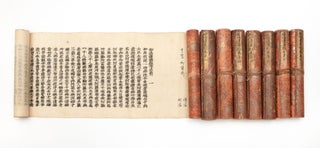
Nice set, with minor browning. Preserved in two hantao.
❧ Li Qinpu 李勤璞, Man-Meng-Han sanwen hebi jiaokeshu de fanyi banxing (shang) 《满蒙汉三文合璧教科书》的翻译颁行(上), Manyu yanjiu 2014, No. 1: pp. 34-42; idem, “...(xia)” 下, Manyu yanjiu 2014, No. 2: pp. 67-74; Qu Liusheng 屈六生, “Lun Qingmo Manyu de fazhan: Jianping Man-Meng-Han sanwen jiaokeshu” 論清末滿語的發展——兼評《滿蒙漢三合教科書》, Manyu yanjiu 2004, No. 2: pp. 60-65; He Jiani, “From Empire to Nation: The Politics of Language in Manchuria (1890-1911),” PhD dissertation, Cambridge, 2018; Hartmut Walravens, “Vorläufige Titelliste der Mandjurica in Bibliotheken der USA,” Zentralasiatische Studien 10 [1976]: pp. 551-613.
Price: $7,500.00
Item ID: 10372