![Item ID: 10355 Kōwa gyofu 皇和魚譜 [Catalogue of Fish from Our August Japan]. Tanshū 栗本丹洲 KURIMOTO, author, Tsunenori 大淵常範 ŌBUCHI.](https://jonathanahill.cdn.bibliopolis.com/pictures/10355.jpg?width=768&height=1000&fit=bounds&auto=webp&v=1744833130)
![Kōwa gyofu 皇和魚譜 [Catalogue of Fish from Our August Japan].](https://jonathanahill.cdn.bibliopolis.com/pictures/10355_2.jpg?auto=webp&v=1744833130)
![Kōwa gyofu 皇和魚譜 [Catalogue of Fish from Our August Japan].](https://jonathanahill.cdn.bibliopolis.com/pictures/10355_3.jpg?auto=webp&v=1744833130)
![Kōwa gyofu 皇和魚譜 [Catalogue of Fish from Our August Japan].](https://jonathanahill.cdn.bibliopolis.com/pictures/10355_4.jpg?auto=webp&v=1744833130)
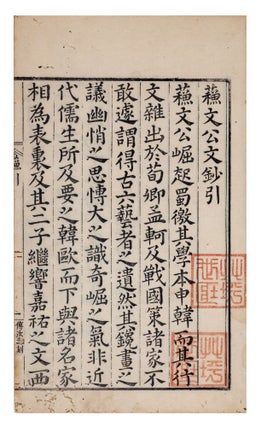
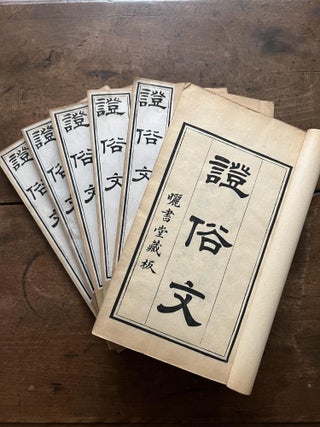
<i>Kōwa gyofu</i> 皇和魚譜 [<i>Catalogue of Fish from Our August Japan</i>].
Numerous black & gray ink woodcut illus. 52 folding leaves. Large 8vo, orig. semi-stiff wrappers (a little tired), new stitching. [Japan]: Shijudō 資壽堂, 1838.
First edition of this rare book by a prominent naturalist-scholar, edited by his grandson. Our book can be seen as reflecting two trends in the intellectual life of late-Tokugawa Japan. The first is the flourishing of honzōgaku 本草學, or “natural studies.” The second is the emergence of kokugaku 國學, or “national learning.” Natural studies developed out of the study of Chinese texts of materia medica, known as texts on “roots and grasses,” or bencao in Chinese and honzō in Japanese. Within honzōgaku, the natural environment was described within a classificatory framework proposed by Chinese scholar Li Shizhen 李時珍 in his Bencao gangmu 本草綱目 [Systematic Materia Medica]. In Tokugawa Japan, honzō texts developed substantially and attracted the interest of large swaths of the educated. Morphological description became more precise, as did illustrations, as can be seen in our book. Scholars and aficionados gathered in clubs and societies, such as the “Association of the Red Rod,” with which the author of our book was associated (Federico Marcon, The Knowledge of Nature and the Nature of Knowledge in Early Modern Japan [Chicago: 2015], p. 189).
The trend of “national learning” was a brand of scholarship that focused on Japanese historical sources and sought to identify a particularly Japanese identity vis-à-vis that of China. Our book might not go that far in its exaltation of things Japanese (the title is, however, telling), but Kurimoto and his grandson frequently highlighted the peculiarity of Japan’s natural environment and the way of life that it had produced. Tsunenori quoted his grandfather as saying, “Our land is a one of fish and salt. Our daily sustenance comes from scaly creatures [e.g., fish] and crustaceans. These are like the cows and sheep of that other land [China].” A more exhaustive catalogue of Japan’s fish was thus necessary.
Tsunenori also did not shy away from criticizing Li Shizhen. He remarked that in Bencao gangmu, the records of marine fish contained many errors, such as the statement that the eel only had male individuals and no females. Li had included such mistakes because he had relied on hearsay and not what he had seen with his own eyes. Furthermore, Tsunenori quoted Tanshū as saying that the idea that trout can cure lump-like swellings in the abdomen, sheat fish can stem malaria, and the sillago (kisu 鼠頭) can break down the poison of the stingray were “all things transmitted by people of this country, and now we have tested its veracity, and it turned out marvelously effective. However, the medical books of that other country [of China] say nothing of this.” A book like ours could fill these lacunae, they suggested.
Kurimoto Tanshū (1756-1834) was the second son of Tamura Ransui 田村藍水 (1718-76), who was the naturalist known for his successful cultivation of ginseng in Japan. Tanshū was adopted by the Kurimoto family, into which he married. He met Philipp von Siebold in Edo and gave him drawings of Japanese fish and crustaceans, which subsequently influenced the book series Fauna Japonica (1833-50).
Ōbuchi Tsunenori (1816-89) studied with Tanshū and was a shogunal physician. There are Prefaces by Masujima Ko 増島固 (1769-1839), a Confucian scholar conversant in natural studies, and Kitamura [Nao]hiro 喜多村[直]寛 (1804-76), a fellow shogunal physician.
From the library (a gift from his grandfather), with his seals and manuscript notes pasted-in, of Itō Tokutarō 伊藤篤太郎 (1866-1941), botanist and a grandson of Itō Keisuke 伊藤圭介 (1803-1901), physician and biologist who studied Western science under Franz von Siebold during the 1820s. A professor at the University of Tokyo, Keisuke was a leader in public health projects and science policy from the beginning of the Meiji period through the rest of his career and established a popular method of vaccination.
Fine copy, preserved in a new box.
Price: $8,500.00
Item ID: 10355