![Item ID: 10348 [“Treatise on the Barbarians in Nagasaki”]. KIYŌ BANSHI 崎陽蛮志.](https://jonathanahill.cdn.bibliopolis.com/pictures/10348.jpg?width=768&height=1000&fit=bounds&auto=webp&v=1718898153)
![[“Treatise on the Barbarians in Nagasaki”].](https://jonathanahill.cdn.bibliopolis.com/pictures/10348_2.jpg?auto=webp&v=1718898153)
![[“Treatise on the Barbarians in Nagasaki”].](https://jonathanahill.cdn.bibliopolis.com/pictures/10348_3.jpg?auto=webp&v=1718898153)
![[“Treatise on the Barbarians in Nagasaki”].](https://jonathanahill.cdn.bibliopolis.com/pictures/10348_4.jpg?auto=webp&v=1718898153)
![[“Treatise on the Barbarians in Nagasaki”].](https://jonathanahill.cdn.bibliopolis.com/pictures/10348_5.jpg?auto=webp&v=1718898153)
![[“Treatise on the Barbarians in Nagasaki”].](https://jonathanahill.cdn.bibliopolis.com/pictures/10348_6.jpg?auto=webp&v=1718898153)
![[“Treatise on the Barbarians in Nagasaki”].](https://jonathanahill.cdn.bibliopolis.com/pictures/10348_7.jpg?auto=webp&v=1718898153)
The Russians Are Coming, The Russians Are Coming
[“Treatise on the Barbarians in Nagasaki”].
1853. Manuscript on paper. Eight fine brush & color-wash full-page illus. & nine smaller illus. in the text. 35 folding leaves. 8vo, orig. semi-stiff wrappers with the orig. title-slip, orig. stitching. [Japan]: 1853.
A manuscript copy of a rare work, never published, on the Russian expedition, led by Vice-Admiral Evfimi Vasilevich Putiatin (1803-83), to Japan in 1853. We find no copy of a work with this title in WorldCat, and only two copies in Japan.
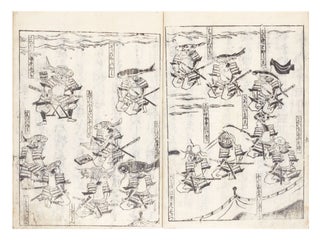
The paintings of individual members of the Russian delegation are uncommonly finely rendered with very skillful gradations of color and tone.
Around the same time as Commodore Perry set out for Japan, Russia also dispatched an expedition to the country. The goal was to open Japan up for trade, which Russia had failed to do on previous visits several decades earlier. “The expedition set forth from Kronstadt in October, 1852. A second vessel was added by Putiatin at Portsmouth. The expedition after fitting out the two ships weighed anchor on January 18, 1853, for the voyage around the Cape of Good Hope. They arrived in Canton at the end of June in 1853…
“It was only after ten months at sea that the Russians were able to come to the shores of Japan on August 21, 1853. The first visit at Nagasaki of three months until November 23, 1853, is like that of Perry inasmuch as the Russians were received with suspicion and their efforts seemed to be of no avail. The Japanese put off their answer. After a trip to China the Russians returned to Nagasaki on January 3, 1854. Each side found the other strange. The Japanese had had only a limited contact with the Americans under Perry and suspected all foreigners. The Russians were meeting new customs, new food and new ways of viewing problems. The negotiations were complicated by the use of four languages. The Japanese statements had to be translated into Dutch, then into Chinese and finally into Russian” (William A. Laney, S.J., review of Russia’s Japan Expedition of 1852-1855 by George Alexander Lensen, Monumenta Nipponica 11.3 [1955]: p. 105).
The visit eventually led to the Treaty of Shimoda in early 1855, which clarified the two country’s borders and opened Japanese ports for trade with Russia. Our book shows that the Japanese side took great interest in the Russian visitors, who are depicted with great care and skill here. There are very fine detailed, colored illustrations of the envoy (shisetsu 使節), the second in command, officers, guards, musicians, flagbearers, and a sailor. Different flags used by the Russians are also shown.
The images are signed ranga ō 蘭畫翁, “the Old Man of Dutch Painting.” We believe this might refer to Kawahara Keiga 川原慶賀 (1786-after 1860), who is known to have depicted the Russian expedition of 1853.
The Russians long had contact with China, and they had staff knowledgeable in Chinese on hand. It appears that the letter that they brought with them, as had been the case in their most recent earlier visit, was written in Chinese. Our book contains a Japanese translation of the letter. It contains what appear to be some undigested Chinese phrases, such as liang ge da diguo 兩個大帝國, used to refer to the “two great empires” of Russia and Japan. Russia itself is in the title of the letter, referred to as eluosi 俄羅斯 (ultimately from Manchu oros) rather than with the Japanese name roshiya 魯西亜, used elsewhere in both the letter and the book as a whole.
Fine copy, some slight thumbing. Preserved in a wooden box.
❧ William McOmie, The Opening of Japan 1853-1855 (Global Oriental: 2006), Chaps. 5 & 7.
Price: $25,000.00
Item ID: 10348