![Item ID: 10333 Manuscript on paper, entitled “Kanrei higen” 管蠡秘言 [“Comments on Narrowmindedness to Be Kept Secret”]. Ryōtaku 前野良沢 MAENO.](https://jonathanahill.cdn.bibliopolis.com/pictures/10333.jpg?width=768&height=1000&fit=bounds&auto=webp&v=1732698061)
![Manuscript on paper, entitled “Kanrei higen” 管蠡秘言 [“Comments on Narrowmindedness to Be Kept Secret”].](https://jonathanahill.cdn.bibliopolis.com/pictures/10333_2.jpg?auto=webp&v=1732698061)
![Manuscript on paper, entitled “Kanrei higen” 管蠡秘言 [“Comments on Narrowmindedness to Be Kept Secret”].](https://jonathanahill.cdn.bibliopolis.com/pictures/10333_3.jpg?auto=webp&v=1732698061)
![Manuscript on paper, entitled “Kanrei higen” 管蠡秘言 [“Comments on Narrowmindedness to Be Kept Secret”].](https://jonathanahill.cdn.bibliopolis.com/pictures/10333_4.jpg?auto=webp&v=1732698061)
An “Idealistic Portrayal of Western Conditions” with<br><br> “Unfavorable Implications...for Sinocentric Moral Culture”
Manuscript on paper, entitled “Kanrei higen” 管蠡秘言 [“Comments on Narrowmindedness to Be Kept Secret”].
37 manuscript diagrams in the text, some partially in color. 53 folding leaves. 8vo (240 x 170 mm.), orig. semi-stiff wrappers, old stitching. [Japan]: 1843.
A manuscript copy of an unpublished radical rejection of the dominant ideology of Tokugawa Japan.
In “Kanrei higen,” written in 1777, “Maeno rejected the Chinese Five Elements theory, traditional cosmology, and the Confucian view of nature. In their place he advanced the Aristotelian idea of four elements and other theories of Western science.” Maeno offered an “idealistic portrayal of Western conditions and the unfavorable implications this had for Sinocentric moral culture. Maeno equated superior Western achievements in Naturkunde or natural science, with a superior morality...
“We must also understand Maeno’s knowledge of world geography and the Western moral superiority he extrapolated from it…Maeno believed that Columbus was a ‘savior of other lands,’ a missionary of impeccable moral standing. After discovering the New World, he and other Europeans, such as Magellan and Amerigo Vespucci, founded many colonies there. For Maeno, the known world had expanded to include two new continents, North and South America...
“To Maeno, the religious teaching of the Western sages was best; that Christianity had spread over far more of the globe than any other teaching proved this. Better knowledge of world geography and demography broke down the Sinocentric Middle Kingdom world view held by Japanese Confucians: ‘Buddhism has spread over one-fifth of Asia, Confucianism, one-tenth of Asia. Christianity dominates the rest of the world.’ People inhabiting but one-tenth of one of the world’s five continents believed in Confucianism; Christianity had transformed all other nations...Widespread non-acceptance over the globe had to discredit the Confucian Way and Sinocentric culture in Maeno’s eyes.” He decided not to publish the present text, as he believed it would be deemed in violation of bakufu law.
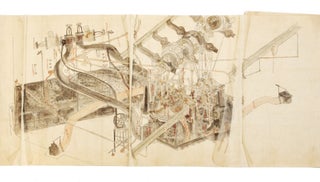
Our manuscript contains a number of illustrations, with depictions of the earth, Japanese and Western writing implements, the “six great continents,” and solar and lunar eclipses.
Maeno Ryōtaku (1723-1803) was a physician and Dutch-studies (rangaku) scholar. According to contemporary testimony, he wanted to “make Rangaku his life’s work, to attain a full mastery over Dutch, and thereby learn about conditions in the West. His great ambition was to acquire the ability to read all their books.” Maeno’s reading of Western works made him critical of Tokugawa institutions. “Maeno probably did more than anyone else to establish systematic instruction in the Dutch language during the mid-Edo period. His numerous works consisted mainly of Dutch primers and translations on a wide variety of subjects, including medicine, natural science, and geography.”
The title is a reference to the expression kanki reisoku 管窺蠡測, “to look at the heavens through a tube and measure the sea using a shell,” meaning to have very narrow insight.
Our manuscript was copied in 1843 by Yamashita Shiken 山下士傔. Manuscript copies are rare; we find no copy in WorldCat, and only three copies held in Japanese libraries.
Fine copy, some worming, occasionally touching characters.
❧ Quotes from Bob Tadashi Wakabayashi, Anti-Foreignism and Western Learning in Early-Modern Japan (Council on East Asian Studies, Harvard: 1986), pp. 47-50. George Sansom, A History of Japan, Vol. 3–“His contributions to Dutch studies were important, for he was a pioneer.”.
Price: $5,500.00
Item ID: 10333
![Manuscript on paper entitled on upper cover: “Taux des fruits du Baillage [sic] de Nuits depuis. BURGUNDIAN WINE, GRAINS.](https://jonathanahill.cdn.bibliopolis.com/pictures/6543.jpg?width=320&height=427&fit=bounds&auto=webp&v=1551724053)