


Weddings & Childbirth
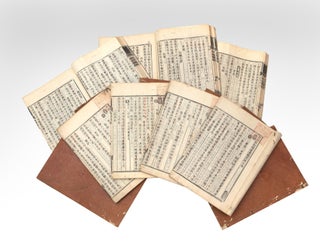
A uniform set of manuscripts on paper, each with individual manuscript label on upper wrapper, dealing with life events.
78 brush & ink (black & occasional red) illus. & several diagrams. 64; 37; 37.5; 43; 68; 21.5 folding leaves. Six vols. Large 8vo (258 x 192 mm.), orig. semi-stiff wrappers, new stitching (a little loose in places). [Japan]: 1785 (copyist’s colophon).
A manuscript set of regulations for various life events and rituals, primarily related to marriage.
The set contains several parts: “Konrei kizai shiki” 婚禮器財式 [“Wedding Implement Regulations”], “Konrei sekijō shiki” 婚禮席上式 [“Wedding Ceremony Regulations”], “Konrei nōsai shiki” 婚禮納菜式 [“Presentation of Food Regulations for the Wedding”], “Konrei rotō shiki” 婚禮路頭式 [“Wedding Roadside Regulations”], “Sanpu shiki” 產婦式 [“Regulations for Pregnant Women”], and “Kanrei shiki” 冠禮式 [“Regulations for the Capping Ceremony”].
Among the Tokugawa-period elite, weddings were lavish affairs regulated by custom. “Wealthy and powerful daimyo ordered magnificent wedding trousseaus for their daughters, and these trousseaus became symbolic of the social rank and the political alliances upon which the marriages were founded...The bride married into the groom’s family, so the trousseau was an important part of the dowry taken over to the groom’s estate in an elegant wedding procession...Common townsmen had a similar tradition, and well-to-do merchants ordered expensive and refined household utensils, furniture, and kimonos for their daughters” (Monika Bincsik, “Japanese Weddings in the Edo Period (1615–1868),” Heilbrunn Timeline of Art History, online). The volume titled “Wedding Implement Regulations” contains illustrations of furniture, styles of clothing, and other items related to the dowery. Appropriate works of literature are listed.
Another volume of particular interest is “Regulations for Pregnant Women” or “Women About to Give Birth.” “Childbirth in the Tokugawa period was by no means the private affair of the woman delivering her baby, but instead an event involving the household (ie 家) as a whole and the village that surrounded it. The development of these two institutions during the fifteenth to seventeenth centuries necessitated the cooperation of women in the immediate and extended family and was accompanied by the rise of customs involving various ceremonies and gift exchanges as both the household and the village welcomed their new member. At the same time, pollution associated with birth (san’e 産穢) imposed restrictions on ritual events central to village life” (Yokota Fuyuhiko, Michael Burtscher, trans., “Childbirth in Japan circa 1700,” Monumenta Nipponica 75.2 [2020]: p. 285). Our manuscript contains sections on forbidden items, recommendations for a good diet, clothing (including an obi belt to support the baby in the womb), screens used during birth to conceal the moment, the washing of the mother, the cloth for receiving the baby, post-natal care, auspicious days, and many other topics. A list of medical books to consult is given along with a formula for a medicine to combat morning sickness.
Ise Sadatake (1718-84) was a high-ranking samurai (hatamoto) and a student of the ceremonial Ise school.
Fine set, some minor worming touching characters and very minor dampstaining.
Price: $4,750.00
Item ID: 10213
![Manuscript on paper entitled on upper cover: “Taux des fruits du Baillage [sic] de Nuits. BURGUNDIAN WINE, GRAINS.](https://jonathanahill.cdn.bibliopolis.com/pictures/6543.jpg?width=320&height=427&fit=bounds&auto=webp&v=1551724053)

![Shozaishu 匠材集 [Dictionary of Renga Poetry [or] Collection of Building Materials. Joha 里村紹巴 SATOMURA.](https://jonathanahill.cdn.bibliopolis.com/pictures/6999.jpg?width=320&height=427&fit=bounds&auto=webp&v=1588723281)
